
Two Trades, One Strategy
In an act of solidarity, LIUNA and IUPAT team up to coordinate organizing, bargaining, and more
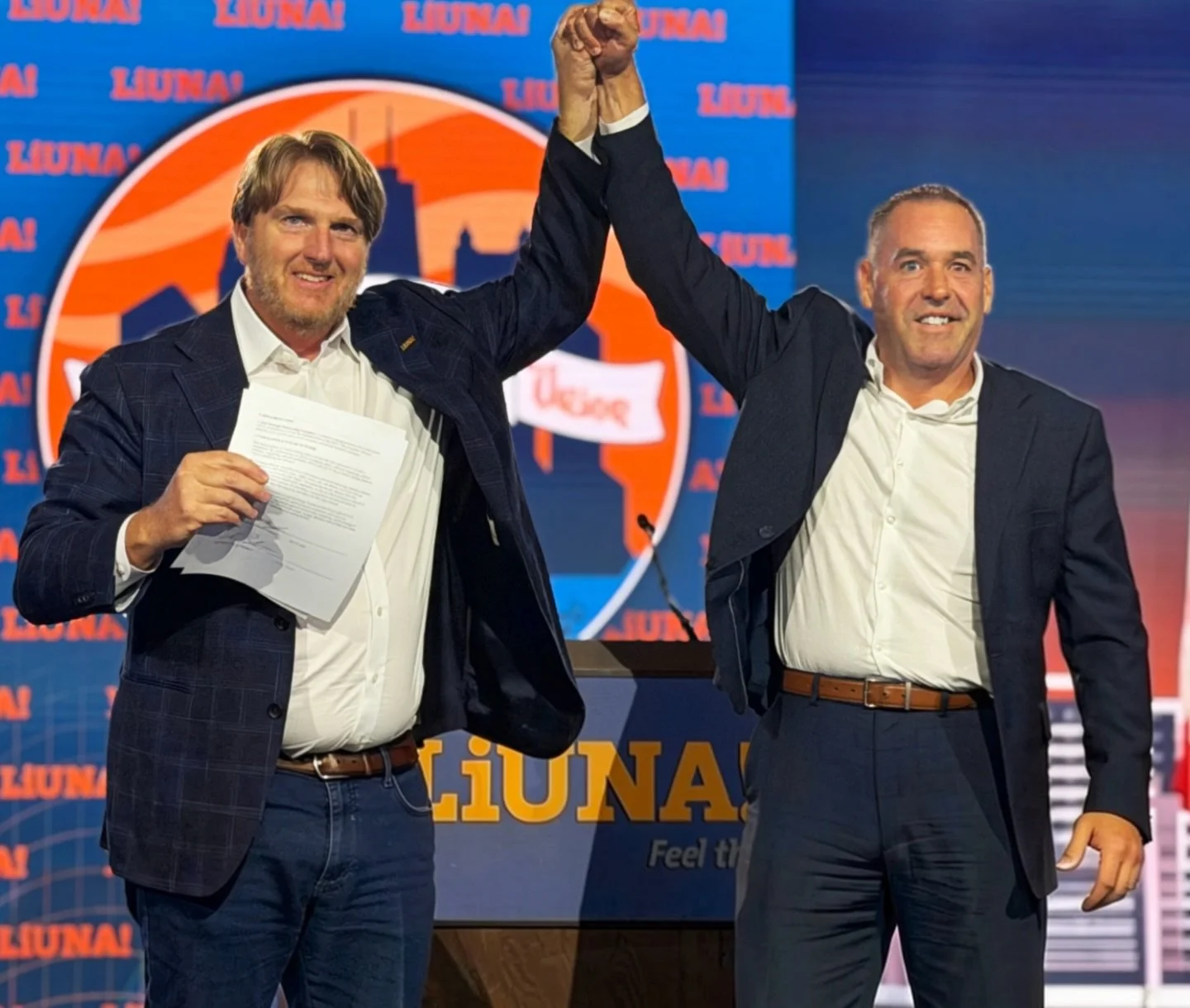
ON THE FINAL DAY of last month’s Multi-Regional Conference, LIUNA General President Brent Booker (left) and IUPAT General President Jimmy Williams Jr. (right) signed a memorandum of understanding meant to strengthen organizing, coordinate strategy, and build worker power across the two unions.
Building trades unions regularly trumpet solidarity, whether on the picket line, at the bargaining table, or in the halls of political power.
Now, the laborers and painters are putting that solidarity in writing.
In a historic pairing, the Laborers’ International Union of North America (LIUNA) and the International Union of Painters and Allied Trades (IUPAT) have signed a memorandum of understanding calling for closer cooperation between the two unions with distinct trades, traditions, and interests.
Announced late last month, the agreement commits the laborers and painters to collaboration on organizing, job protections, and other priorities.
LIUNA General President Brent Booker said the unions’ long-standing relationship made a formal alliance a natural next step.
“Working together and sharing some resources [...] will allow us both to grow stronger together.”
“Both of our unions have worked together closely for years, and at this critical moment for organized labor, we felt like a partnership could only make both of our organizations stronger,” Booker said. “This is what 21st-century solidarity looks like. Standing together means more power for our members, and we will continue to work together to build on these gains.”
In an email to Organized Labor, Booker explained how the partnership could work in practice.
“This agreement is a memorandum of understanding outlining how each union will work together through organizing, corporate affairs, health and safety, and by leveraging our collective power to benefit our members,” he said. “In practical terms, this means aligning with each other on the local level to identify our joint priorities, and showing up together to achieve them.”
The memorandum details several commitments, including joint organizing and recruitment, coordinated communications, and lobbying efforts, as well as syncing contract expiration dates.
After signing the memorandum, Booker and IUPAT General President Jimmy Williams Jr. addressed LIUNA’s 2026 Multi-Regional Conference in Chicago.
Williams called for the unions to move beyond ceremonial solidarity. He proposed aligning contracts across North America so that employers face both unions together, including when members strike.
“Let’s align our goddamn contracts on the same day — every place in North America — to show the industry we have power,” he told the audience in a video posted on IUPAT’s Instagram account.
LIUNA and IUPAT said the partnership will draw on their respective strengths to raise industry standards and expand economic opportunities for workers.
“Our combined work in the infrastructure and energy sectors and expertise in the construction finishing trades creates a formidable force capable of setting higher industry standards and prosperity for our members and for all workers in our industry sectors,” Booker said. “Our combined capital assets and state-of-the-art training facilities create more leverage and more power for members in both unions. Practically speaking, 700,000 members are always going to be stronger together.”
Williams added that IUPAT and LIUNA acknowledge that with labor and unions constantly under threat, fighting separately isn’t enough.
“Being alone in these times of crisis is not going to get it done,” Williams said in the video. “When you think about over 75 years of us getting our asses handed to us by big business, by corporate interests […] we’ve been running the same tired playbook for the past 75 years as a movement.”
LIUNA represents more than a half-million members across North America; IUPAT represents more than 140,000.
NABTU, the North American building trades umbrella federation that includes both unions and traditionally coordinates activity among the construction trades, did not respond to a request for comment by press time.
What the LIUNA–IUPAT alliance will look like on jobsites and at bargaining tables remains to be seen.
“Each of our unions has areas where we have strong memberships and history and other areas where we have worked harder to build,” Booker said. “Working together and sharing some resources like training facilities will allow us both to grow stronger together. For this to be really successful, it needs to be locally driven, so we will be mapping that out in the coming months.”