
Path to Parity
Crafts workers’ latest contract with SFUSD closes the pay gap
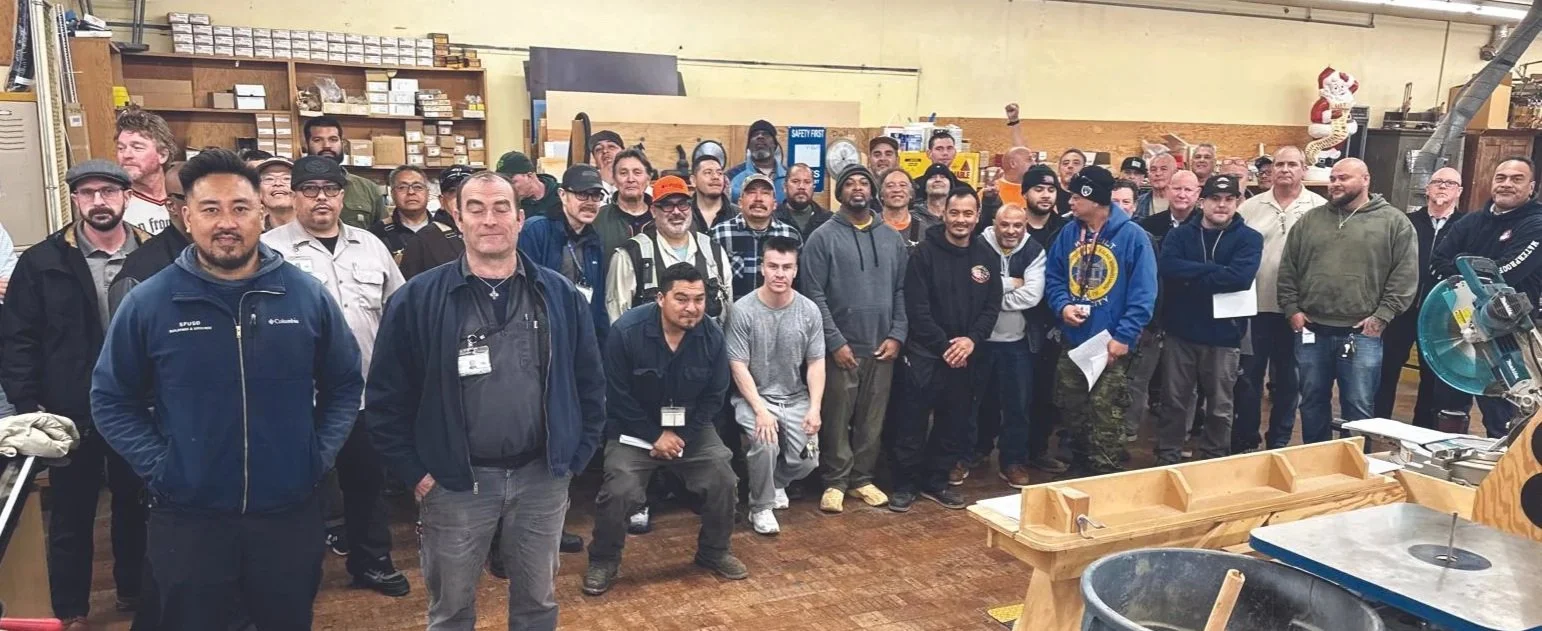
A coalition of building trades members ratified a new multi-year contract with SFUSD last month. | Photo: Rudy Gonzalez
After years of strategic bargaining, crafts workers employed by the San Francisco Unified School District have won a new contract that finally puts them on a path toward pay parity with other workers performing the same jobs.
Rudy Gonzalez, secretary–treasurer of the San Francisco Building and Construction Trades Council and chief negotiator for the SFUSD Crafts Coalition, said the contract is the result of a multi-year campaign to reverse decades of wage disparity that has wreaked havoc primarily on workforce stability.
“We did the hard work, we made the case, we showed it in the numbers, we showed it in the data of them losing qualified people, and we stayed laser-focused on our goal.”
Although coalition workers are hired through the same civil service merit system as workers in other city agencies and hold the same classifications, the district had lagged behind city wage rates for decades. The result was a recruitment and retention crisis, as skilled tradespeople left the coalition for better-paying public jobs elsewhere.
“We did the hard work, we made the case, we showed it in the numbers, we showed it in the data of them losing qualified people, and we stayed laser-focused on our goal,” Gonzalez said.
The coalition made a strategic plan to close the gap.
“We finally achieved a contract that puts us on a path to city parity over the life of this three-year contract,” Gonzalez said.
John Chiarenza, a longtime business agent with UA Plumbers and Pipefitters Local 38, said the fight for parity has been a long-established goal.
“It was a little bit of a battle, but we ended up getting a deal that we can live with and that our members can live with,” he said. “I’m actually happy with how negotiations went.”
Chiarenza, whose union has nine members at SFUSD, credited Gonzalez’s leadership in helping to secure the deal.
“Rudy did a hell of a job,” Chiarenza said.
Osha Ashworth, IBEW Local 6 assistant business manager, explained that Local 6 negotiates its own contract with the school district concurrently alongside the broader Crafts Coalition. She characterized the outcome as a major breakthrough.
Ashworth said the parallel bargaining process allowed the unions to build off of each other’s gains at the table.
“So, it was kind of piggybacking off of making sure that if one were to get something that was better than the other, then we’re trying to use that to improve both of the contracts and, ultimately, [to negotiate] the best contracts for all of our members working in the buildings and ground units,” Ashworth said.
She said the district’s inability to retain electricians demonstrated why parity matters. Trades workers would complete probation under their civil service classifications and then transfer to better-paying city departments, such as the airport, the Department of Public Works, or Rec and Parks.
That pattern created a costly cycle in which the SFUSD repeatedly trained workers only to lose them once they’d mastered the campuses, buildings, and systems. For example, as electricians became familiar with school sites, electrical closets, and recurring trouble spots, that institutional knowledge would vaporize when workers left for other agencies.
Under the new deal, many classifications are expected to reach parity by the second year of the contract, with others getting there in the third year.
The coalition’s strength, Gonzalez said, comes from solidarity among the crafts, which includes laborers, roofers, plumbers, glazers, teamsters, ironworkers, sheet metal workers, and carpenters.
“I’m really proud of that kind of unity,” Gonzalez said.
That sense of siblinghood also connected the crafts workers to the wider labor movement in the district; Chiarenza said crafts workers overwhelmingly supported the teachers during their recent contract fight.
“We were glad to stand with them,” he said, “and we’re glad that the teachers got a deal that they wanted and we ended up getting a deal we wanted.”
“The members showed a tremendous amount of resolve — of not getting distracted by things that were happening around them,” Gonzalez said, referencing management turnover, leadership changes, the pandemic, and other disruptions over the years.
Gonzalez described the relationship with district managers overseeing the day-to-day operations of buildings, grounds, and trade shops as professional and grounded in mutual respect, particularly in regards to resolving safety concerns and local workplace issues. But he said workers still face frustration with the district’s central office, especially on payroll and human resources, which directly affect working conditions and create unnecessary stress.