
The Tax That Froze the Pipeline
How did a well-intentioned tax on high-value real estate transactions backfire for building trades workers?

San Francisco’s Proposition I tax was sold in 2020 as a way to make the biggest real estate deals pay more and fund affordable housing. Now, with construction stalled and jobs on the line, the building trades, developers, and City Hall are pushing to roll it back. This is the first article in a series digging into the City’s transfer tax.
Massive developments are complicated undertakings. To turn renderings into reality, skyscrapers and brand-new neighborhoods rely on tens of millions of dollars, thousands of tradespeople, and a choreographed mix of financing, approvals, and construction. When one piece of that puzzle stops working, even well-intentioned policy can throw a project off course.
Enter San Francisco’s real estate transfer tax, which doubled the taxes due on many large property transactions after voters passed Proposition I in 2020, all with the promise of funding affordable housing. Six years later, with development still stalled, Mayor Daniel Lurie and District 5 Supervisor Bilal Mahmood are pushing to rewrite the tax through the BUILD Act, backed by the San Francisco Building and Construction Trades Council, developers, and investors who say the City needs to make it easier to build again.
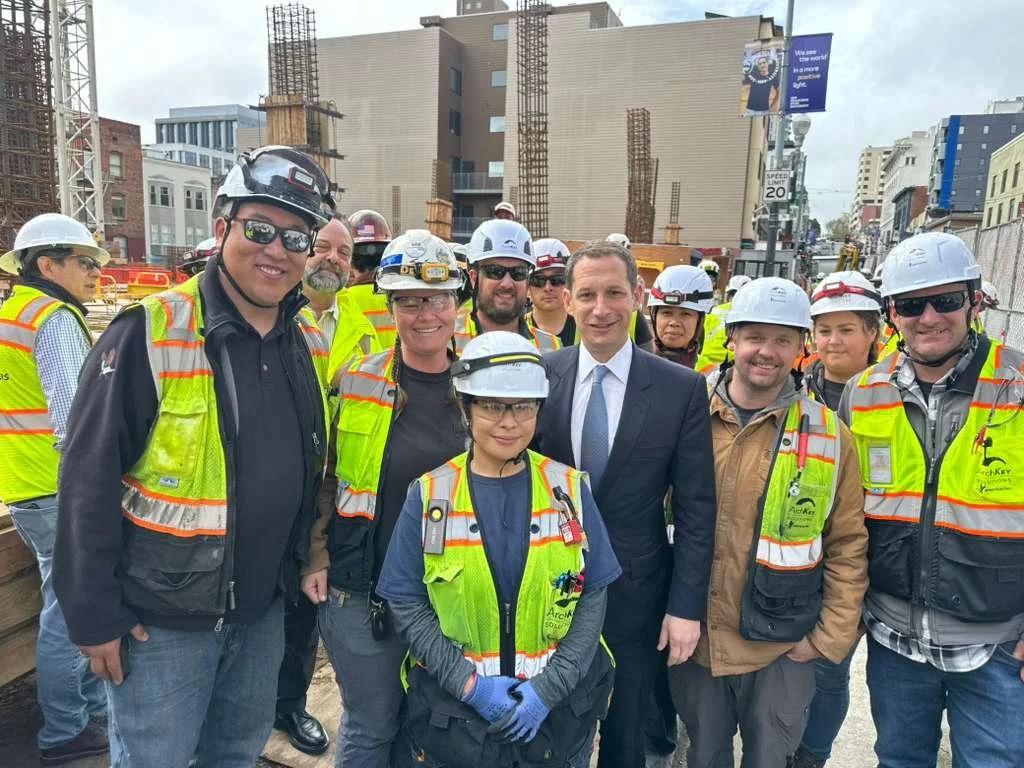
Rank-and-file building trades members gather on February 25 to announce the BUILD Act at a news conference with Mayor Daniel Lurie alongside crews working at 1111 Sutter Street, where high-road labor and pension funding resulted in a transfer tax reduction.
The Prop I Problem
In 2020, at the height of the Covid pandemic, Prop I passed with 58% of the vote. The measure, which was authored by then-District 5 Supervisor Dean Preston, doubled the transfer tax on high-value transactions — particularly large commercial property sales — and was pitched as both a mansion tax and a way to fund affordable housing.
From the outset, the SF Building Trades Council didn’t support Prop I, noting concerns that a transfer tax increase could discourage new construction and unfairly penalize union retirees whose pension dollars go to fund such projects.
“Sadly, Prop I has done what the Building Trades Council at the time said it would do,” said SF Building Trades Council Secretary–Treasurer Rudy Gonzalez, who was with the SF Labor Council at the time of Prop I’s passing. “We don’t say that with levity — that what we warned could happen happened, that it contributed to a stalled construction economy.”
Prop I doubled the transfer tax on real estate transactions above $10 million, raising the rate on some major deals from 3% to 6%. The SF Building Trades Council warned at the time that the increase could make new construction harder to finance, a concern that many critics agree has since been borne out.
Prop I also failed to secure one of its central political promises: to fund affordable housing. That was never guaranteed because the measure passed as a general tax and not a special tax. As a result, the revenue flowed into the City’s general fund.
‘A Terrible, Terrible Law’
Oz Erickson, principal and chairman of the real estate development company Emerald Fund, didn’t mince words when discussing the real estate transfer tax, calling the 6% rate “crazy” and “a major impediment to building.” He pulled no punches when addressing Preston’s Prop I, either, characterizing it as “profoundly anti-union” and claiming the measure was “maliciously labeled as a mansion tax.”
“It was just egregious,” Erickson said. “It was a terrible, terrible law, and Supervisor Preston didn’t listen to any of the complaints and marketed it falsely, as if it was going to be charged on billionaires, and instead it was charged on the backs of union workers.
“It hurts housing. It hurts union jobs. It’s a bad tax,” Erickson said.
San Francisco’s high transfer tax rate is unlikely the sole reason projects are stalling, but developers are quick to point out that it’s a big factor when banks, real estate investment trusts, and pension funds are deciding where to invest capital.
The City’s top-end transfer-tax rate of 6% is at the far high end of big-city transfer taxes — well above nearby Bay Area cities like Oakland and Berkeley.
Dallas, by contrast, sits at the other end of the spectrum, without any real estate transfer tax.
Prop I also taxes large, multi-phase projects multiple times as they move through different financing stages. Internal transfers can trigger the transfer tax even when the same developer still controls the overall project.
Reducing the tax burden on large, job-creating projects could help unlock capital and move long-approved developments from the drawing board to construction, resulting in building trades jobs and other positive economic activity.
“It taxes the very investors who are looking to put money to work,” said Associate Capital Managing Partner Enrique Landa. “For us as developers, when we go try to find money to get buildings built and put your members to work, we have to get a higher return in San Francisco.”
“The intention here is reforming [the transfer tax] in a way that’s revenue-neutral but actually helps to accelerate housing the way we need to.”
The Plan
To spur development, Lurie and Mahmood have introduced the Balanced Update to Incentivize Local Development (BUILD) Act, which will lower transfer tax rates on large housing developments in particular. The SF Building Trades Council supports the plan.
The BUILD Act would roll most multifamily, commercial, and other non-single-residence transfers back to pre-2020 levels, setting the rate at 2.75% for deals of $10 million or more and 3% for deals above $25 million, while leaving rates unchanged for single-family homes and transactions below $10 million.
Mahmood framed the BUILD Act as both a housing measure and an economic recovery package, arguing that San Francisco’s current transfer tax structure has made it harder to build the housing the City needs while also putting construction workers out of work.
According to the City, the package could lower construction costs by roughly $32,850 per unit.
“The intention here is reforming [the transfer tax] in a way that’s revenue-neutral but actually helps to accelerate housing the way we need to,” Mahmood said.
The supervisor described Prop I as well-intentioned, noting it passed at a time when city leaders were urgently seeking ways to boost revenue and support affordable housing. But he said the City now has several years of evidence indicating that the policy resulted in some unintended consequences.
“One, it’s raising the cost of construction by $30,000 a unit,” Mahmood said. “Two, it didn’t actually dedicate funding for affordable housing.”
Ted Chandler, formerly of the AFL–CIO Housing Investment Trust and now a consultant to the group, said the proposed changes are necessary to keep pension capital flowing into new housing projects.
“I think it’s fair to say that it will increase the number of opportunities for us to invest in rental housing in San Francisco by making more projects financially feasible to build,” he said.
To offset concerns about revenue loss from Prop I rollbacks, the City also plans a November 2026 ballot measure to expand the transfer tax to certain currently exempt transactions, like some foreclosure-related transfers. At the same time, Lurie has directed city departments to seek longer-term funding options for affordable housing.
“We’re trying to be very measured about how we do this,” Gonzalez said. “We don’t want to throw the baby out with the bathwater.”