
To Truly Honor Workers’ Memorial Day, We Must Get Proactive About Worker Safety
Every year at the end of April — on the 28th, to be exact — we recognize Workers’ Memorial Day. We pause. We read names. We say “never again.”
Then, we go back to work in a system that still treats those deaths as the cost of doing business.
Here in San Francisco, the skyline tells the story. Union labor built this city — its towers, its hospitals, its transit, and its schools. But behind every crane and every jobsite, there’s a question that matters more than any ribbon-cutting: Is everyone going home at the end of the day?
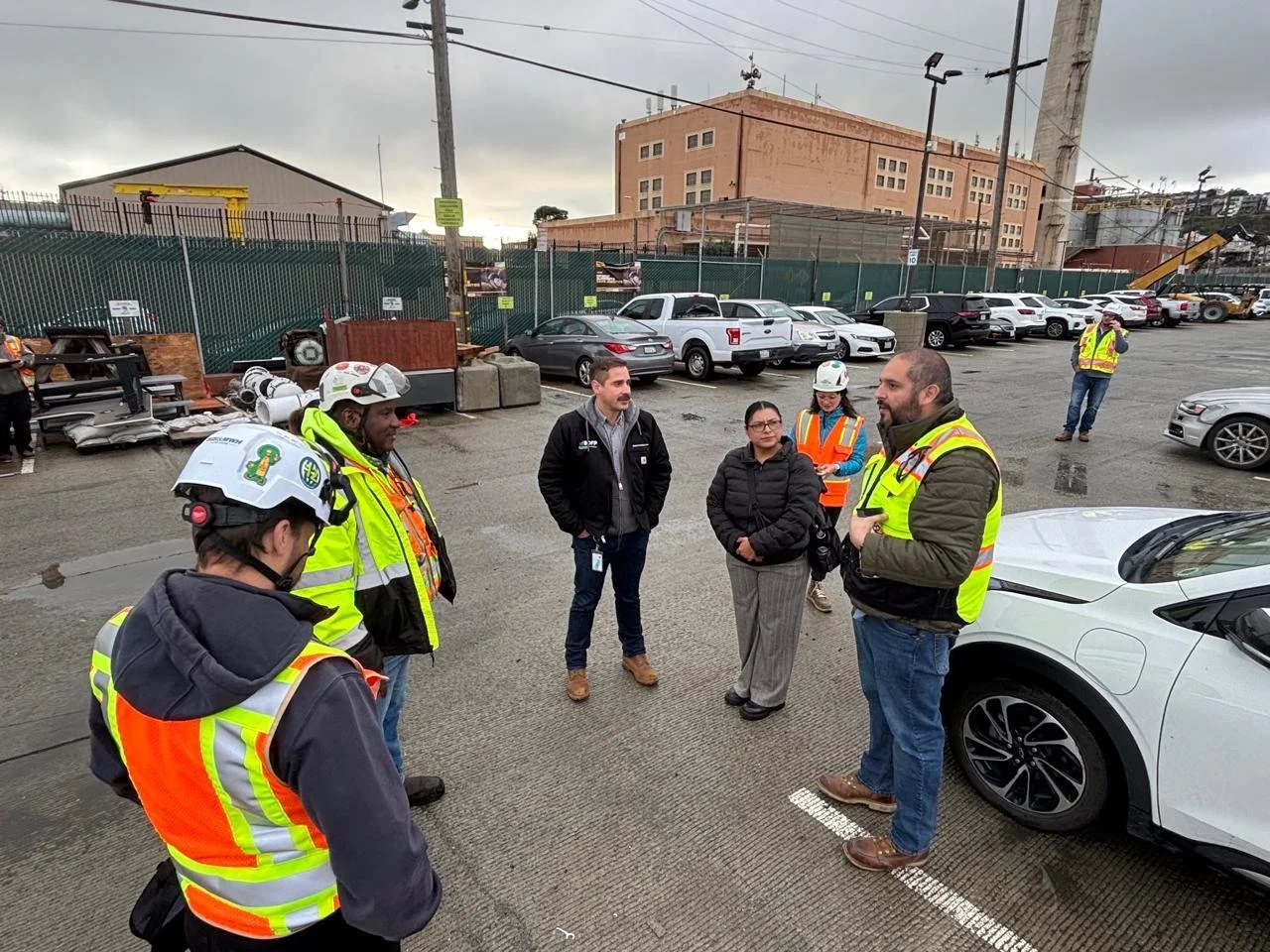
Gonzalez (far right) participates in a regular safety stand-down with all trades on a jobsite.
Workers don’t die due to bad luck. They don’t die because the job is “inherently dangerous.” They die because someone made a decision. A corner got cut. A schedule got pushed. Training got skipped. Safety got treated like a cost instead of a requirement.
That’s what Workers’ Memorial Day is about. Accountability.
Every year, the AFL–CIO puts out its Death on the Job report. And every year, it tells the same story. Workers are killed. Workers suffer career-ending injuries. Ultimately, families pay the price.
Here in California, the numbers back it up. Nearly 80 construction workers lost their lives in a single year, according to the latest available data, thanks to a culture and a society that wrongly accepts these tragedies as inevitable.
In the building trades, we know what the alternative can be because we build it every day. Look at the SFPUC Biosolids jobsite with MWH/Webcor. That’s what it looks like when safety is taken seriously.
On that project, trades workers have logged more than a million work hours without one lost-time incident. There’s real oversight, and there are real standards. There are workers who have the training — and the authority — to speak up. As I write this column, we’ve gone 681 days without a lost-time incident. That didn’t happen by accident. It happened because it’s a PLA job done the right way. Even in a union town like San Francisco, that fight isn’t over.
“We must continue to be clear about one thing: If you’re going to build in San Francisco, you build safe. Union jobs are the standard here, rather than the exception.”
There are still plenty of contractors chasing the lowest bid and cutting whatever corners they can, and, too often, getting away with it. There are still developers who want it built fast but don’t want to pay for it to be built right. And there are still decisions being made about enforcement, funding, and oversight that determine whether safety is a reality or merely a concept that exists on paper.
You can’t claim to support working people in this city and look the other way on that. You can’t celebrate new development while ignoring the conditions workers face building it.
If we’re serious about honoring the workers we’ve lost, then we need to be just as serious about the decisions being made right now, both on jobsites and in City Hall. We must demand enforcement that actually has teeth — and real consequences for bad actors.
We must also continue to invest in apprenticeship and training that sets the standard. We must continue to be clear about one thing: If you’re going to build in San Francisco, you build safe. Union jobs are the standard here, rather than the exception.
On Workers’ Memorial Day, we remember the workers who didn’t make it home. We stand with their families.
But that’s not enough. If we’re going to honor our fallen siblings, then we have to fight for the people still on the job.