Op-Ed: California Was Built by Workers — Not Billionaires
This column was written by Kim Tavaglione, executive director of the San Francisco Labor Council, and Rudy Gonzalez, secretary–treasurer of the San Francisco Building and Construction Trades Council.
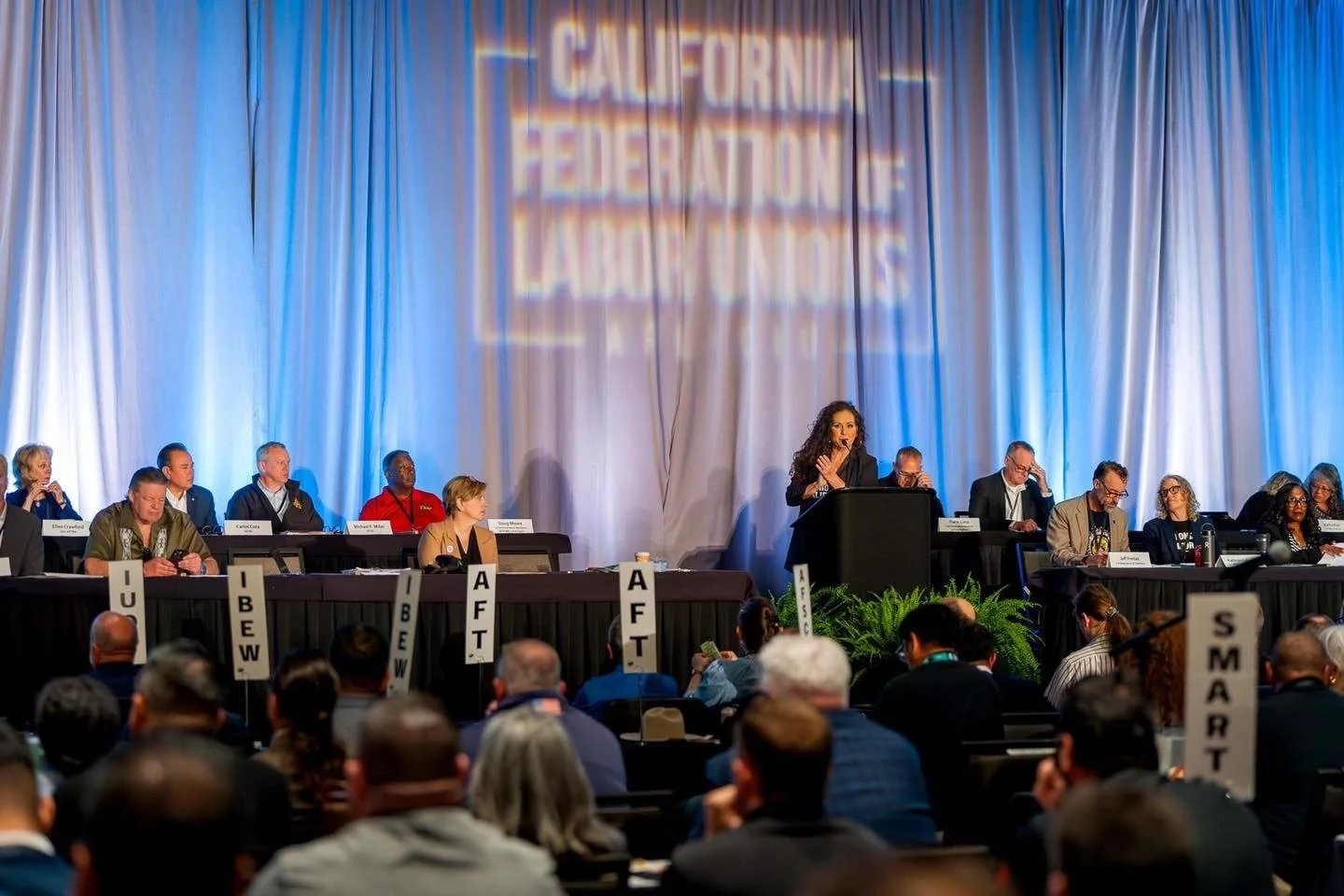
President Lorena Gonzalez, at the podium, leads a meeting of the California Federation of Labor Unions in Sacramento on Monday, March 16. | Photo: CA Fed Facebook
A recent column in The San Francisco Standard warned that proposals to tax extreme wealth could harm California’s economy and shape the coming governor’s race.
People can disagree about tax policy. That’s a legitimate debate. But focusing only on whether billionaires should pay more misses the bigger issue California can’t afford to ignore: the growing gap between the extraordinary wealth at the top of our economy and the affordability crisis facing the workers who keep this state running.
That gap is reshaping California’s economy, our communities and our politics. Pretending it isn’t there won’t make it go away.
Every time California considers asking the wealthiest people here to contribute a little more, we are warned that Silicon Valley will leave, innovation will collapse, and the economy will suffer. We’ve heard these arguments for decades, and somehow the conclusion is always the same — that working people are expected to accept the consequences.
But California wasn’t built by billionaires. It was built by workers.
Construction workers built the roads, bridges, transit systems and power infrastructure that enable businesses to operate. Nurses keep our communities healthy. Teachers educate the next generation of Californians. Hotel workers, janitors, grocery clerks, warehouse workers, firefighters, electricians and laborers keep this state moving every day.
That’s the real foundation of California’s economy — not AI or speculative finance. And right now, many of those foundational workers are struggling to afford life in the state they helped build.
“The impact of organized labor has never been limited to the number of people who carry a union card. When workers organize and win better pay, safer job sites or stronger labor laws, those gains raise the floor for entire industries.”
Across San Francisco and California, housing costs are pushing working families out of the communities where they grew up. People doing essential jobs increasingly can’t afford to live where they work. The real question in this debate isn’t innovation versus fairness. It’s whether California is willing to confront the widening gap between the people creating wealth in this economy and the people struggling to live in it.
On one side of that conversation is the California Federation of Labor Unions (CA Fed) — a coalition of democratic worker organizations representing millions of working people throughout this state. Unions are not billionaire-funded political projects. They are democratic institutions that are beholden to their membership. Workers elect their leaders. Workers vote on priorities. Workers decide what they fight for.
The labor movement includes construction workers, hospitality workers, healthcare workers, teachers, janitors, logistics workers, grocery workers and public employees. It represents both private-sector and public-sector workers who believe it’s only fair that economic growth should benefit the people doing the work.
On the other side, we have a handful of extraordinarily wealthy tech investors who increasingly want to shape California’s politics around protecting their own interests. That’s not grassroots politics. That’s a special-interest agenda.
When wealthy interests take shots at leaders like Lorena Gonzalez — as David Crane did in his column for The Standard — it says less about her and more about what’s at stake. She represents a coalition of workers who believe California’s economy should work for more than just the wealthiest few.
Gonzalez has spent her career fighting for working people. In the Legislature, she took on corporations that were misclassifying workers and denying them basic protections. Today, she leads the CA Fed, representing millions of workers across industries.
Critics like to point out that union membership represents a relatively small share of Californians. While technically true, that argument misses the mark by not acknowledging how the labor movement actually works.
When workers organize and win better pay, safer job sites or stronger labor laws, those gains don’t stay inside union halls. They raise the floor for entire industries. Non-union employers are forced to compete, and standards for all workers go up. Wages rise.
“California didn’t become the fourth-largest economy in the world because billionaires ran the state. It earned that title because workers made it happen.”
That’s how working conditions have improved in this country for generations — not just for union members, but for everyone who works for a living. The impact of organized labor has never been limited to the number of people who carry a union card.
Workers across California are watching what’s happening in our economy. Over the past few decades, the gap between the very wealthy and everyone else has grown dramatically while the cost of living — especially housing — has skyrocketed. People notice when the system stops working for them.
That frustration doesn’t disappear. It shows up in our politics.
Donald Trump didn’t come out of nowhere. He ascended to power in a country where millions of people were coming to grips with an economy that no longer worked for them.
California should be paying attention to that lesson. Because regardless of what someone thinks about a billionaire tax, ignoring inequality and affordability will only make these problems far worse.
If working people feel like there is no path forward in the state they helped build, the consequences will show up not just in our economy but in our politics. Let Silicon Valley investors pick the next governor, or listen to the workers who built this state.
California didn’t become the fourth-largest economy in the world because billionaires ran the state. It earned that title because workers made it happen.
If California is going to remain a place where working people can build a life, then the people who build this state should have a real voice in shaping what comes next.