
Building Unity
Labor rings out at the 2026 California Democratic Convention
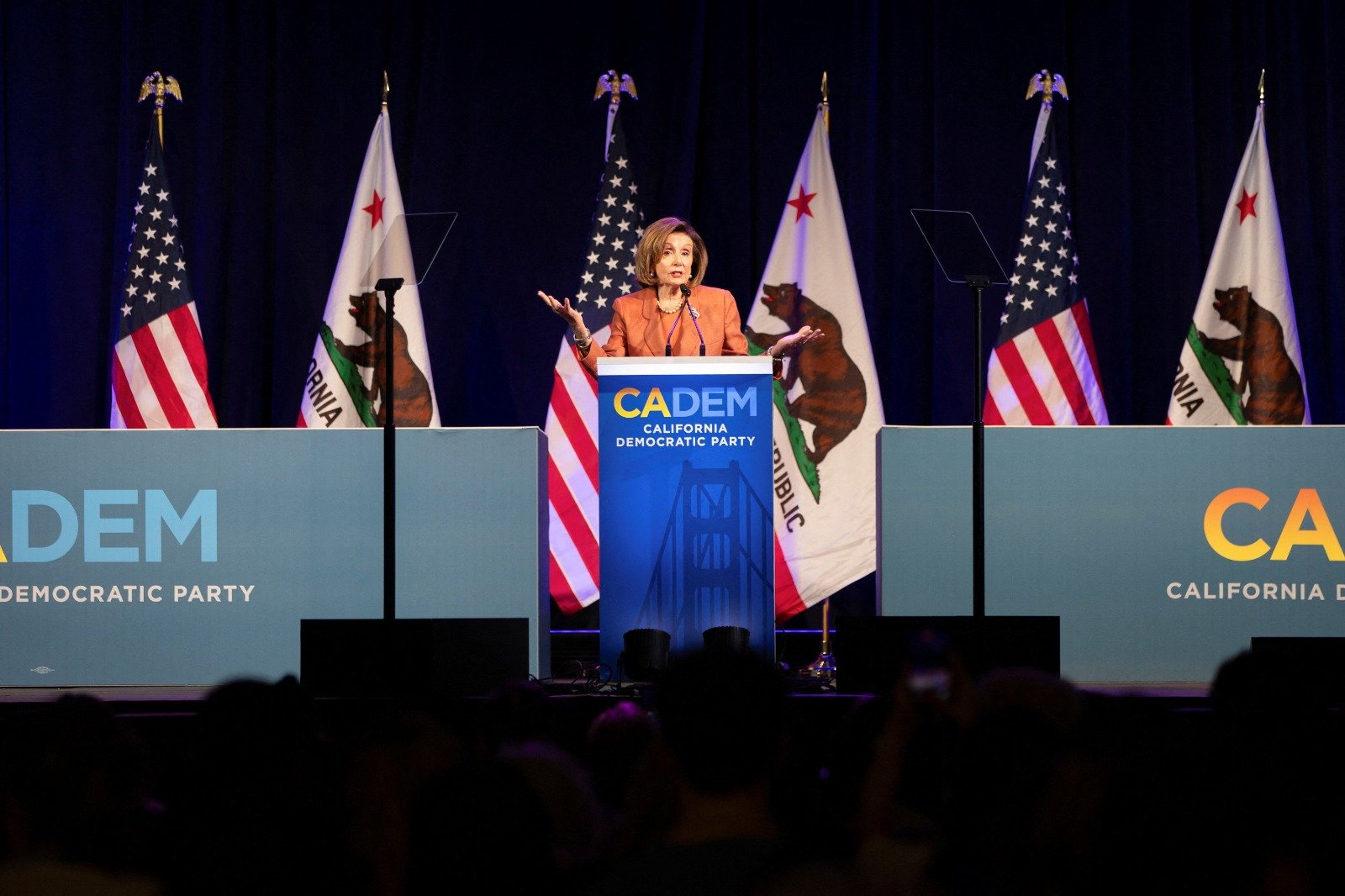
Speaker Emerita Nancy Pelosi addresses the crowd at the California Democratic Convention in San Francisco on Saturday, February 21. | Photo: Reuters
Labor unions shared a strong voice at the 2026 California Democratic Convention, capturing the attention and backing of political candidates, delegates, and supporters of various ballot measures. The next step is to ensure all the talk results in action — permits, funding, and encouragement of construction projects of all types; advocacy and money for career technical education and apprenticeships; and stronger regulatory protections for union and worker power. The hope is that the benefits of these goals will be realized by labor unions, individual workers, and students alike.
Approximately 4,000 people attended the convention. That total includes candidates and their staffs, party delegates, official observers, presenters at the 54 exhibitor booths, press, and even family members of all categories of the above. The event began on Friday, February 20, and wrapped on Sunday, February 22, and was hosted at Moscone Center West in San Francisco.
Rudy Gonzalez, secretary–treasurer of the SF Building and Construction Trades Council, was present throughout the weekend and hobnobbed on every floor. His conversation partners ranged from members of Operating Engineers Local 3 to Eleni Kounalakis, the current lieutenant governor of California who is now running for state treasurer.
“Democrats brought tremendous energy to San Francisco, and union trades helped power it,” said Gonzalez of the event. He named council affiliates Sign and Display Local 510, Teamsters Local 2785, and IBEW Local 6, whose members all performed work on-site at Moscone and helped make the convention a success, he said.
“Organized labor was visible throughout the event, from hospitality suites and vendor booths to delegates engaging elected officials and activists on union-backed campaigns,” Gonzalez said. “We were especially proud to take part in the dinner honoring Speaker Emerita U.S. Rep. Nancy Pelosi.”
Gonzalez paid special attention to staff at the booth for the California Billionaire Tax Act. This measure would levee an emergency tax on billionaires to address shortfalls in funding for the state’s healthcare system. He visited with local and state politicians at a private party for California Assemblymember Matt Haney (D–District 17), who formerly served as District 6 supervisor in San Francisco. Gonzalez also observed how delegates from Bay Area unions outside the SF Building Trades Council were voting in order to understand how to form stronger bonds with them.
By the last day of the convention, no single gubernatorial candidate had received 60% or more of delegates’ votes. Therefore, the California Democratic Party did not endorse a candidate for governor. This outcome presents a serious concern for the party in that the top two finishers vying for the office could both be Republicans. California’s rules mandate that the top two candidates — regardless of party — move forward to the November general election.
U.S. Rep. Eric Swalwell (D–CA District 14) currently holds the lead in public polls. In mid-March, the Service Employees International Union (SEIU) California endorsed Swalwell for governor. As this story is being written, Swalwell still commands less than 30% of the vote. Other candidates for the seat include former state controller Betty Yee; former state attorney general Xavier Becerra; Katie Porter, who served as U.S. representative for California’s 47th congressional district (Orange County) from 2023 to 2025; and billionaire Tom Steyer.
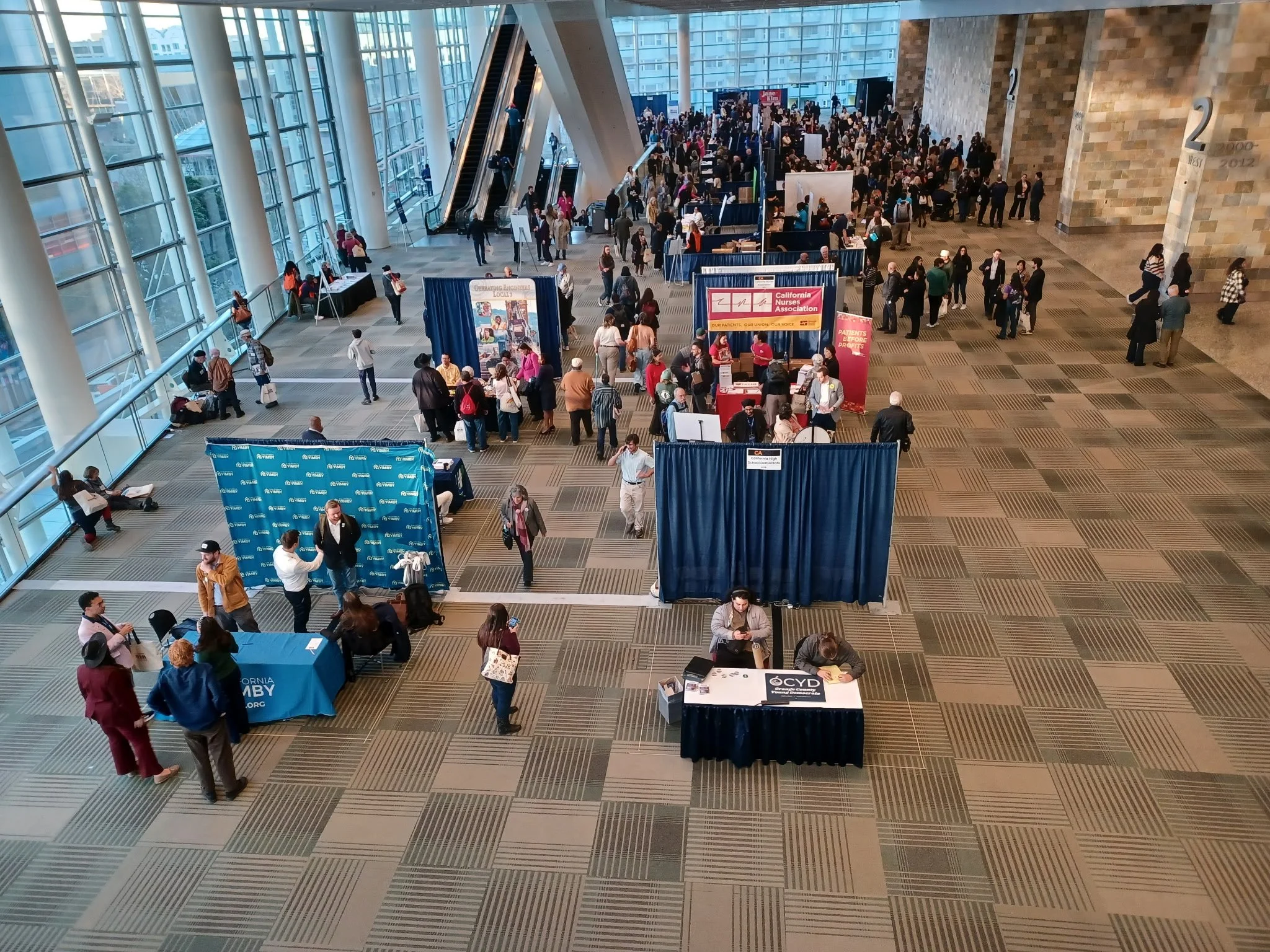
A view from above at Moscone Center shows a range of organizations’ booths at the 2026 California Democratic Convention. | Photo: Jessica Zimmer
One Booth After Another
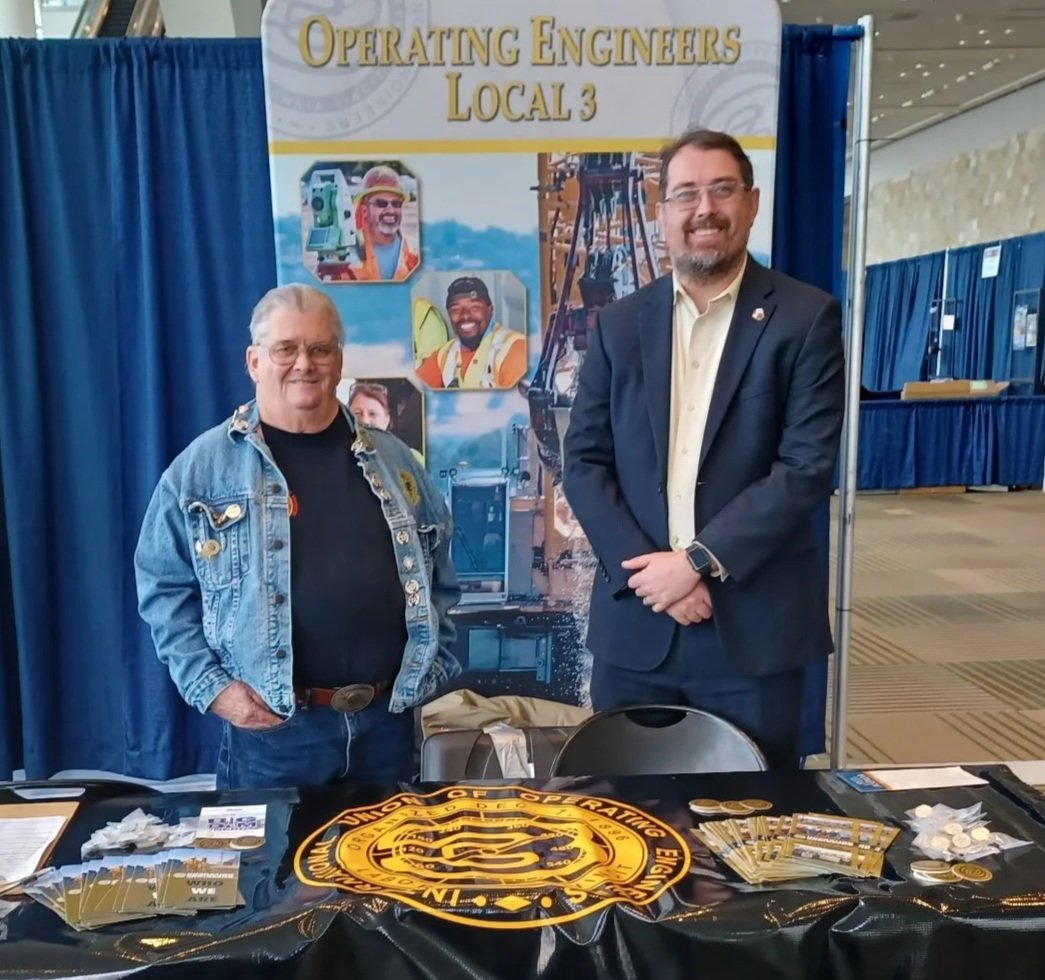
Retiree Bill Meyers and Deputy Political Director Patrick Boileau of Operating Engineers Local Union 3 man the OE 3 booth at the convention. | Photo: Jessica Zimmer
Retired and active members alike from various locals used their booths to share information with delegates about opportunities to work in the trades. They also talked about which construction projects they supported and would generate jobs for union members.
Operating Engineers Local 3 Deputy Political Director Patrick Boileau was manning one of those booths.
“We’re here to educate the party on heavy equipment operators, who we are, and what we’re building — right now, that’s infrastructure,” he said. “We’re advocates for the California High-Speed Rail project. In San Francisco, we want to see more work on the seawall, which helps manage sea level rise.”
OE 3 also supports the downtown rail extension project, a.k.a. The Portal, to extend Caltrain service from Fourth and King streets and bring California High-Speed Rail access to the Salesforce Transit Center.
“Political candidates have been very receptive so far,” Boileau said. “These issues don’t just help us, but all of California. California state assemblymembers and congressional candidates have come to us to discuss these topics.”
OE 3 booth presenters proudly discussed OE 3’s training center in Rancho Murieta, about 16 miles outside of Sacramento. This facility trains apprentices and journey-level workers as heavy equipment operators, mechanics, and surveyors.
At the IBEW booth, Local 6 Business Manager and Financial Secretary John Doherty — who also serves as secretary–treasurer of the California State Association of Electrical Workers (CSAEW), the IBEW’s statewide body — said the booths were a way to not just spread the word about unions but also to introduce himself and other members as individuals.
“We want candidates and delegates to know who the CSAEW is and what our members do,” Doherty said. “We also want to share information such as apprenticeship contacts.”
Doherty said a labor lawyer who represents workers employed by PG&E visited the IBEW booth to talk about issues such as worker safety and organizing.
At the booth for the State Building and Construction Trades Council of California (SBCTC), SBCTC Legislative Advocate Mike West said visitors had lots of questions about trades apprenticeship programs and getting work.
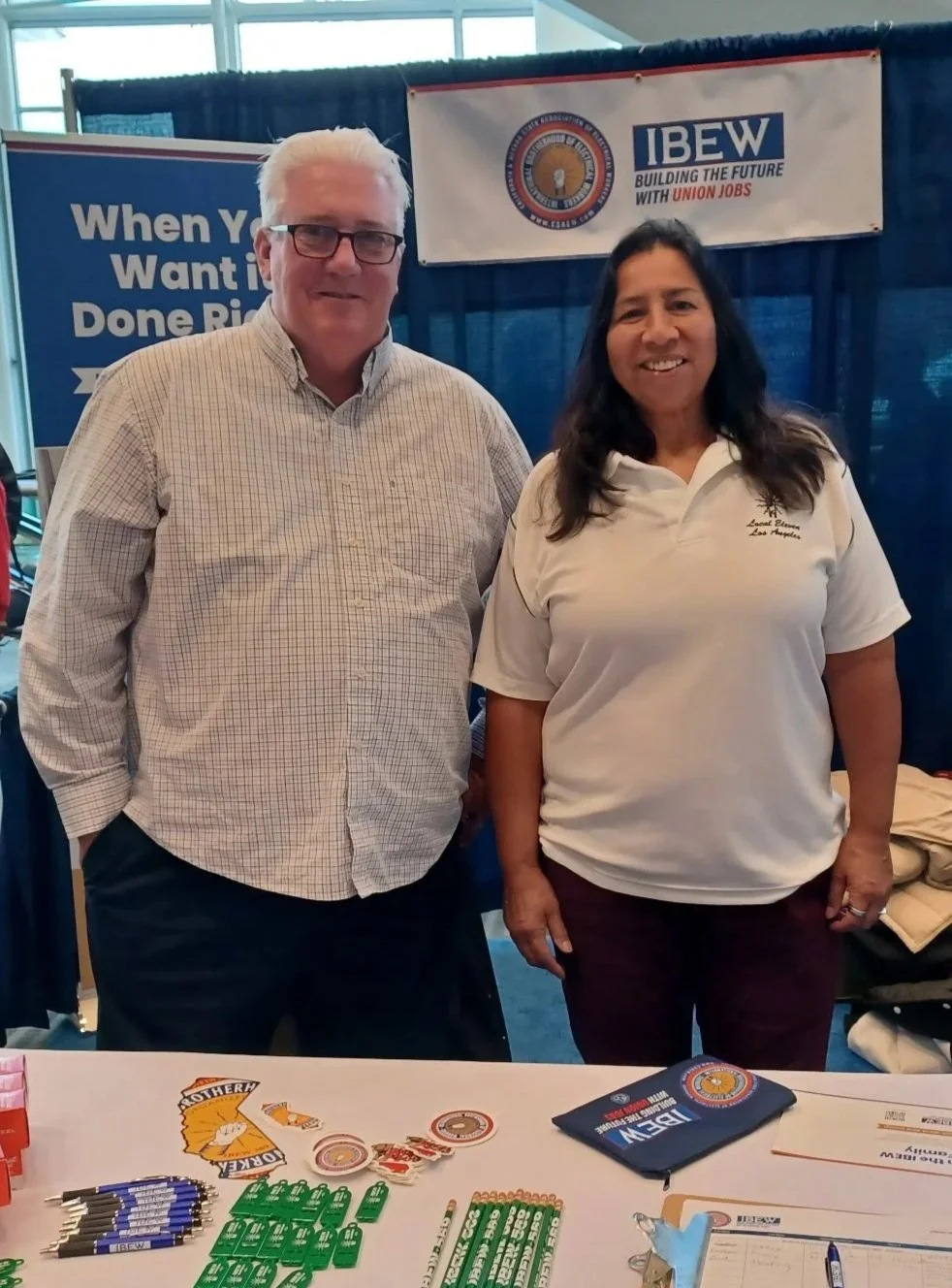
IBEW Local 6 Business Manager and Financial Secretary John Doherty and IBEW Local 11 Director of Women’s Recruitment and Support and Compliance Diana Limon hold down the fort behind the IBEW booth. | Photo: Jessica Zimmer
“We’ve fielded a couple of questions from candidates about how our endorsement process works,” West said. But the primary concern was getting to the nitty-gritty of services provided to members, as well as representation in general.
“We want to tell people about Helmets to Hardhats, to assist military veterans in getting into the trades,” West said. “We also want to share the number of affiliates we have and the total number of people we represent.”
The SBCTC’s priorities include a living wage, good healthcare benefits for union members, and opportunities to retire with dignity.
Just around the corner was the booth for the Sierra Club. This environmental organization is opposed to some construction projects that would generate jobs for union members, including the proposed Sites Reservoir.
Sites would store up to 1.5 million acre-feet of water diverted from the Sacramento River in a reservoir in the Sacramento Valley, west of Maxwell. The reservoir would hold water supplies during drought years. Sites would involve building several large dams and two large tunnels. It would also flood 13,200 acres of woodland and wetland habitat. The Sierra Club argues that the diversion of water from the Sacramento River would pose a threat to endangered native fish species, including Chinook salmon.
As the umbrella organization for 14 trades unions and a major national environmental organization sat almost back-to-back, there wasn’t much outreach or interaction between the two groups in an attempt to reach a consensus on projects like Sites. The avoidance of such issues at the convention showed that the tough conversations between labor and environmentalists might need to come further down the road.
Some delegates expressed concern about “setting up a false choice between labor and the environment.”
“I care about both,” said Carol Reed, a delegate from Contra Costa County who currently works in information technology and is a member of the United Federation of Food and Commercial Workers International. “Organized labor brought my family into the middle class and allowed my kids to go to universities. [When it comes to labor versus environmentalists], the Democratic party should do everything it can to avoid that conflict.”
A topic that drew Democratic delegates from all industries was healthcare. Douglas Jones, delegate and political organizer for SEIU-UHW (United Healthcare Workers), was one of the presenters at the California Billionaire Tax Act booth. He asked convention attendees to sign petitions to help place the initiative on the ballot in November.
“Gov. Gavin Newsom’s budget proposal takes away Medi-Cal insurance and CalFresh nutritional assistance from over 3 million Californians,” Jones said. “That’s immoral. The one-time tax on billionaires that we’re proposing is extraordinarily vital. People will die if we do not create a solution to help people keep their health insurance. Since Gov. Newsom and the State Legislature haven’t come up with a solution, the only alternative which addresses this problem effectively is this initiative.”
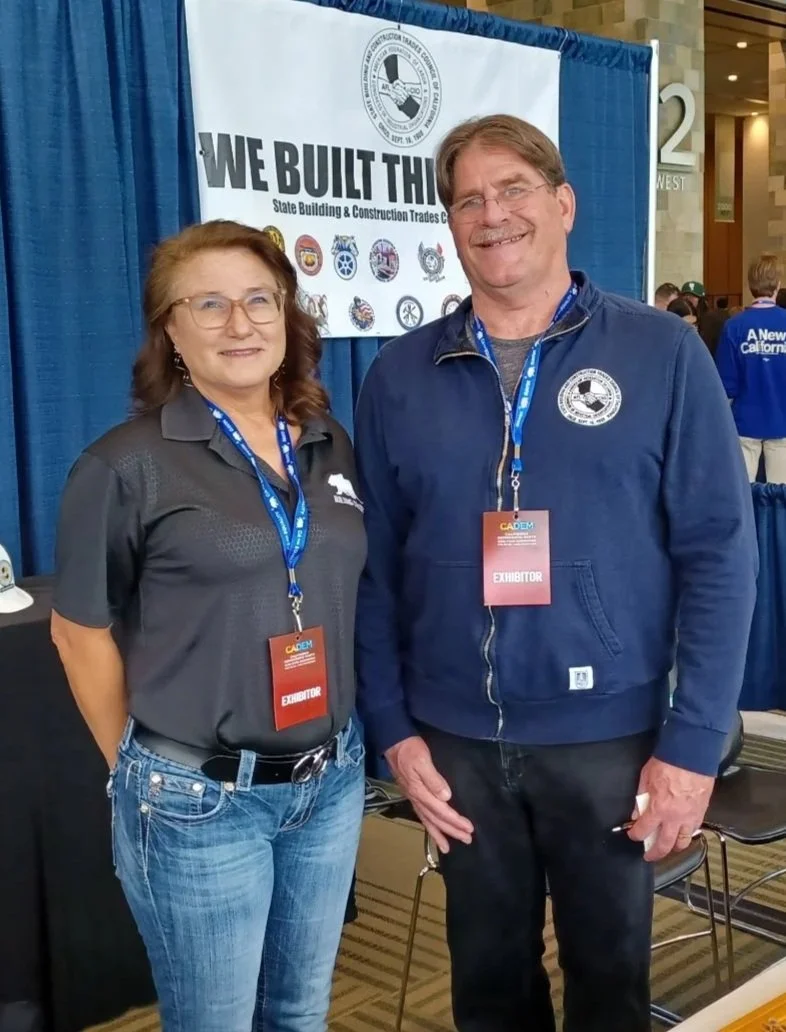
Volunteer Victoria West and Legislative Advocate Mike West stand at the State Building and Construction Trades Council of California booth. | Photo: Jessica Zimmer
The trades weren’t the only unions present at the convention. Other labor unions with booths included the California Teachers Association, the California Nurses Association, the California School Employees Association, United Domestic Workers, and the American Federation of State, County, and Municipal Employees.
On the Floor
During the convention itself, candidates talked up their ties to unions and spoke about labor’s importance in different sessions to drum up support for their campaigns.
One of these sessions was the Labor Caucus, where California Secretary of State Shirley Weber spoke about her parents. Weber is running for re-election for her current seat.
“My father worked in the steel mills of Los Angeles,” she said. “We didn’t have a lot, but we had enough. Labor made sure of that. I’ve been a union member ever since I had a job.”
Gubernatorial candidate Katie Porter attacked President Donald Trump, saying that he’s frozen the effectiveness of the National Labor Relations Board.
“He’s pushed back on the Occupational Safety and Health Act (OSHA),” Porter said. “We know what he’s willing to do. What are we willing to do? We need to push back on Trump.”
California State Superintendent of Public Instruction Tony Thurman, also a gubernatorial candidate, recalled that the cousin who raised him worked at the public university where he came to attend college.
“On my first day of class, I didn’t attend class,” Thurman said. “I was on the strike line with my cousin.”
He added, “No artificial intelligence can replace our workforce. Nothing replaces human judgment and taking care of all our workers.”
President of the California Federation of Labor Unions Lorena Gonzalez said that audience members who weren’t interested in fighting Trump shouldn’t have bothered attending the conference.
“But it’s not just Trump — it’s the big-check billionaires who put him there,” she said.
Gonzalez continued on to repudiate large tech companies that support U.S. Immigration and Customs Enforcement actions and Democrats “who sell out.”
For them, she put it bluntly.
“We have a job at this convention. That is: to reimagine a state where working-class people can afford to pay the f—ing rent.”
“You shouldn’t be taking that money,” she said. “We have a job at this convention. That is: to reimagine a state where working-class people can afford to pay the fucking rent.”
During the Labor Caucus, many candidates stressed their family ties to labor. Most held back from sharing specific strategies to achieve goals.
California State Senator Mike McGuire (D–District 2), however, specifically called out disreputable contractors. He also mentioned OE 3 and sheet metal workers. Bay Area union members in this industry belong to Sheet Metal Workers Local 104.
“We go after contractors in California when they try to steal wages,” McGuire said.
Fiona Ma, California state treasurer and candidate for lieutenant governor, called out the building trades in particular.
“[They’re] shaping our communities,” she said.
Current California lieutenant governor and state treasurer hopeful Kounalakis also stood apart, declaring, “As your treasurer, I’ll build infrastructure and housing,” adding, “We’ll build it all with union labor.”
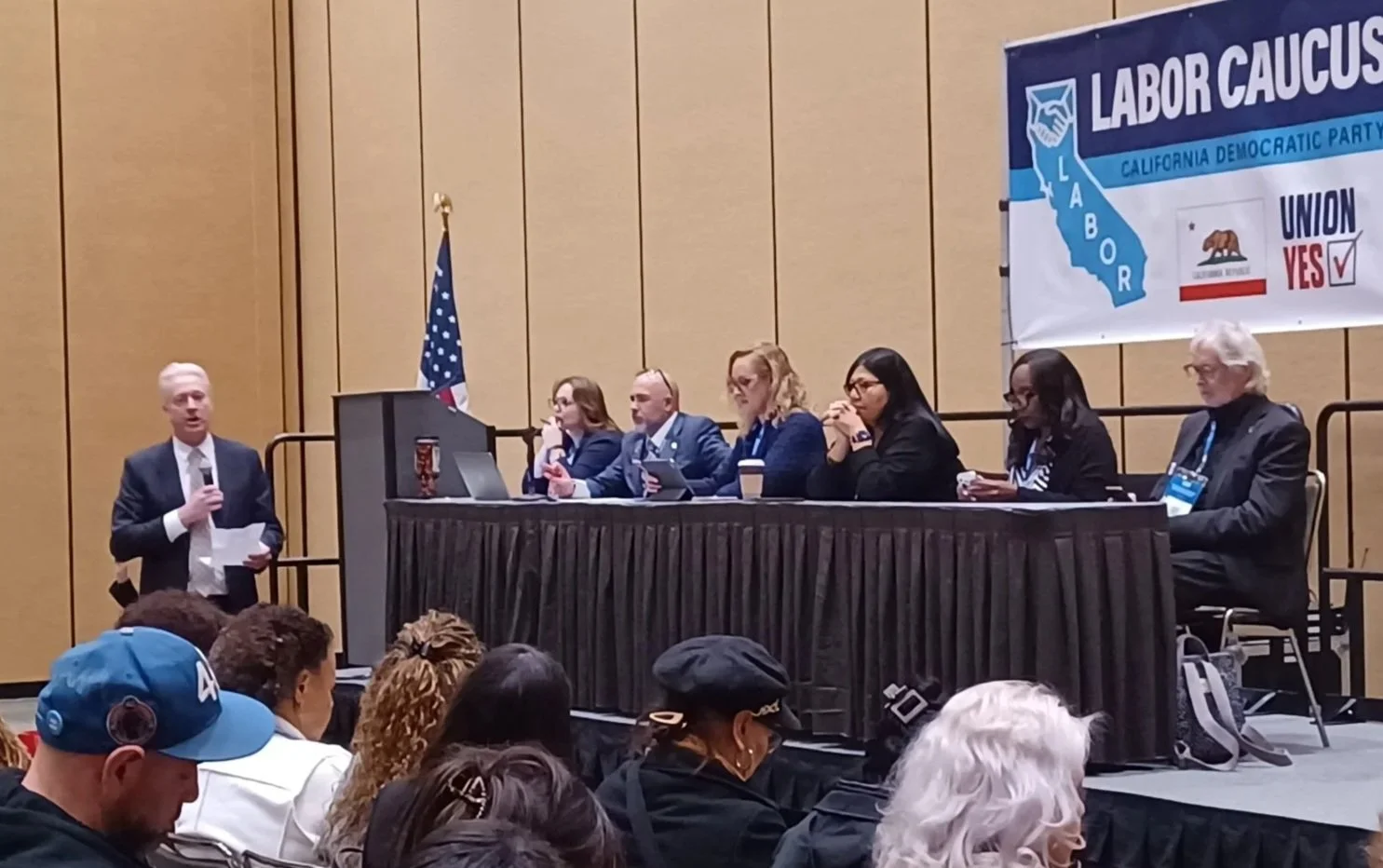
Political candidates speak and answer questions at the Labor Caucus during the convention. | Photo: Jessica Zimmer
Looking Ahead
Days after the Labor Caucus was held, presenters from non-labor groups continued to talk about the topics in that session. Matthew Lewis, director of communications for pro-housing lobbying group California YIMBY, said that the Golden State should be an affordable place to live, work, and raise a family.
“The workers who build our homes should also be able to afford to live in them,” Lewis said. “To get there, we need a much larger construction labor force, a fair wage structure, and millions of new homes that give hard-working Californians a pathway to homeownership.
“California YIMBY is committed to working with our partners in the labor movement on our shared goals of housing abundance and affordability,” he claimed.
Midday events that came after morning sessions included protests against concerns like ICE raids, ice cream socials, and games where participants learned more about topics like healthcare. In the late evening, delegates and union members enjoyed food, beverages, dancing, and music at so-called hospitality suites in the convention center. Socializing lasted until a little past midnight.
From beginning to end, convention attendees never stopped discussing AI. Just outside the Moscone Center’s walls were numerous billboards and signs advertising a glut of AI companies. But AI proved largely to be a target of anger and ridicule inside the conference; AI algorithms have led to downsizing in numerous industries.
John Elward is a UPS driver represented by Teamsters Local 665, based in Rohnert Park. He’s also the campaign manager for his wife, Jackie Elward. She’s running for the California Assembly seat in District 12 in the North Bay.
John Elward said that he’s particularly concerned about the impact of automated vehicles.
“They’re offering $150,000 for anyone to walk away from UPS,” he said. “Members of our local who took up the company on that are those who were going to retire soon anyway. But such offers damage unions. We sued [UPS], but the judges agreed with the company. This company promised more new jobs. The exact opposite is happening.”
AI software for technologies like bulldozers for the construction industry has the potential to encourage the hiring of less skilled workers, according to recent construction industry reporting. This is because the software can accomplish tasks like offering step-by-step instructions in real time as a worker operates a machine. An employer could make the argument that such features would allow for operators with less training and certification.
Of further concern is that AI software is able to calculate the number and severity of a worker’s mistakes during a shift. This capability empowers companies to collect data that would allow them to argue for more discipline and terminations of workers.
One of the gubernatorial candidates who didn’t have a significant presence at the convention was San Jose Mayor Matt Mahan. He’s a favorite of big tech. Mahan has already received the maximum legally permissible contributions of $78,400 each from Google cofounder Sergey Brin, Palantir cofounder Joe Lonsdale, and Y Combinator CEO Garry Tan. In late February, Mahan posted on social media that he has raised over $7 million for his campaign.
On a brighter note, young attendees at the convention were enthusiastic about the presence and strength of labor unions.
George Balan, state president of California High School Democrats, said it was exciting for young Dems to witness the political power of labor unions.
“There are so many jobs in the trades,” Balan said. “So many young people would be directly impacted by strong labor unions. We’re proud to support pro-labor candidates.”
He added that many California high school students don’t know a great deal about unions and the trades — despite their interest.
“Our history classes go very quickly over that topic,” Balan said. “We’d like to see a curriculum that contains more information about labor, labor history, and access to education relating to the trades, including career technical education.”
As the convention drew to a close, members of the press were already speaking about covering the 2026 California Republican Convention. That event is slated for April and will occur in San Diego. As of press time, it’s unclear what statements against labor unions in general and the trades in particular Republican candidates might make. The events on the schedule for the GOP convention are very different: a sunset harbor cruise, a Sunday prayer breakfast, and a Saturday night dinner banquet featuring U.S. Senator Ted Cruz (R–Texas).
Yet California’s Republican candidates will also need the support and effort of trades workers if they expect to build housing and develop infrastructure.
In January, the U.S. Bureau of Reclamation approved the environmental review for the Sites Reservoir. This project alone is likely to require the efforts of many skilled trades workers for years to come. Now is the right time for members of the SF Building Trades Council and other similar labor councils to step up and determine how they intend to negotiate their
next steps.