
The Strength of Mass Timber
Ironworkers, cement masons hone skills on this unique building material
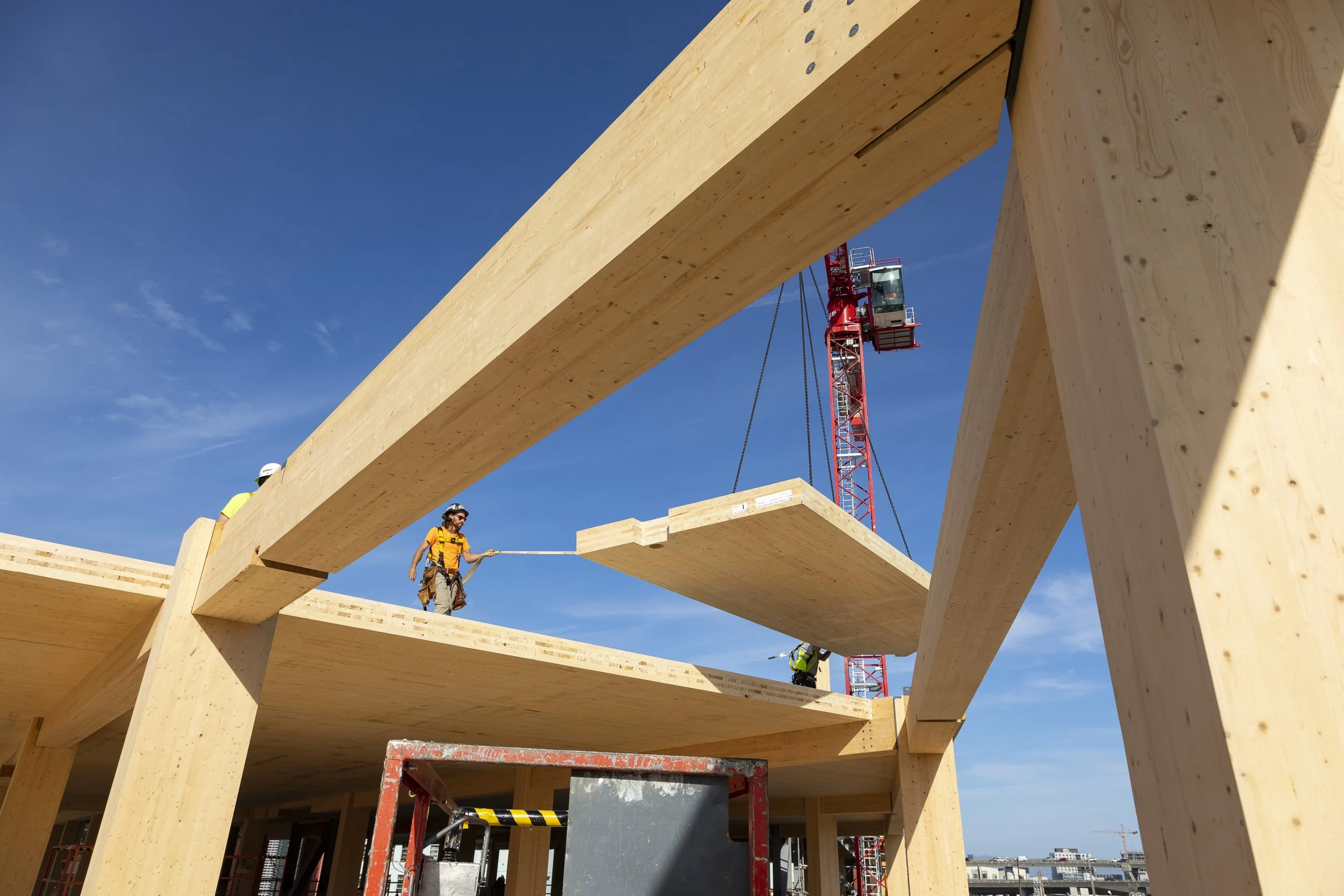
BUILDING TRADES WORKERS utilize panels of mass timber to construct 1 De Haro Street in January 2020. | Photo: Kyle Jeffers
Mass timber is a prefabricated building component that’s emerging as a viable alternative to structural steel in San Francisco and the wider Bay Area. Members of Ironworkers Local 377 and Plasterers and Cement Masons Local 300 are getting in on the ground floor of working with mass timber by undertaking training and projects with the material, sometimes with representatives of the mass timber industry.
The engineered wood product can be utilized by itself or along with structural steel, resulting in a hybrid building. One of mass timber’s most significant selling points is that it’s lighter than steel or concrete. A foundation for a mass timber building can be 30% to 50% smaller than that of a building constructed with only structural steel. This can mean significant construction cost savings.
Mass timber can also be faster to install than steel. Additionally, it boasts a more natural aesthetic. Other advantages include its predictable fire-resistant performance and better seismic resilience during earthquakes.
“Mass timber is essentially pieces of wood glued together, with an insulating sacrificial char layer on all sides,” said Brady Potts, founder and chief operating officer of Mass Timber Group (MTG), a Montana-based industry advocate that shares information and hosts a conference about mass timber. “Think of a thick log — the fire has to slowly burn through that thick timber element until the material cannot meet the load requirement. That gives people inside a structure warning before failure.”
One limitation of using mass timber is that wood can be highly sensitive to vibration.
“This explains why you don’t see a lot of use of mass timber in Mission Bay, where there are biotechnology labs,” said Senior Project Manager and Associate Principal Matt Covall of the SF office of Perkins and Will, a global design firm that’s planned structures using mass timber. “The companies working in the labs don’t want their instrument readings to be inaccurate because of micro-vibrations.”
Many SF developers are currently using mass timber primarily to build tech offices, hotels, and multi-family residential housing.
Builders must protect the wood for mass timber buildings from the elements during transport and construction, especially when it comes to rain, fog, hail, and any other type of moisture. Water or mold can cause the panels to develop streaks or stains that take time, effort, and money to sand off.
In past years, mass timber had to be transported into the City from the Pacific Northwest, Canada, or Europe, as no manufacturing plants existed in California. This is set to change.
A 200,000-square-foot mass timber factory in Redding is being planned by Fabric Mass Timber, an Oakland-based company that manufactures the material, and WRNS Studio, an SF-based architecture and design firm.
“California is the biggest market for mass timber in North America,” said Mark Little, director of preconstruction for Fabric Mass Timber. “This factory will itself be built from mass timber. It’ll increase the extent to which mass timber will be available locally.”
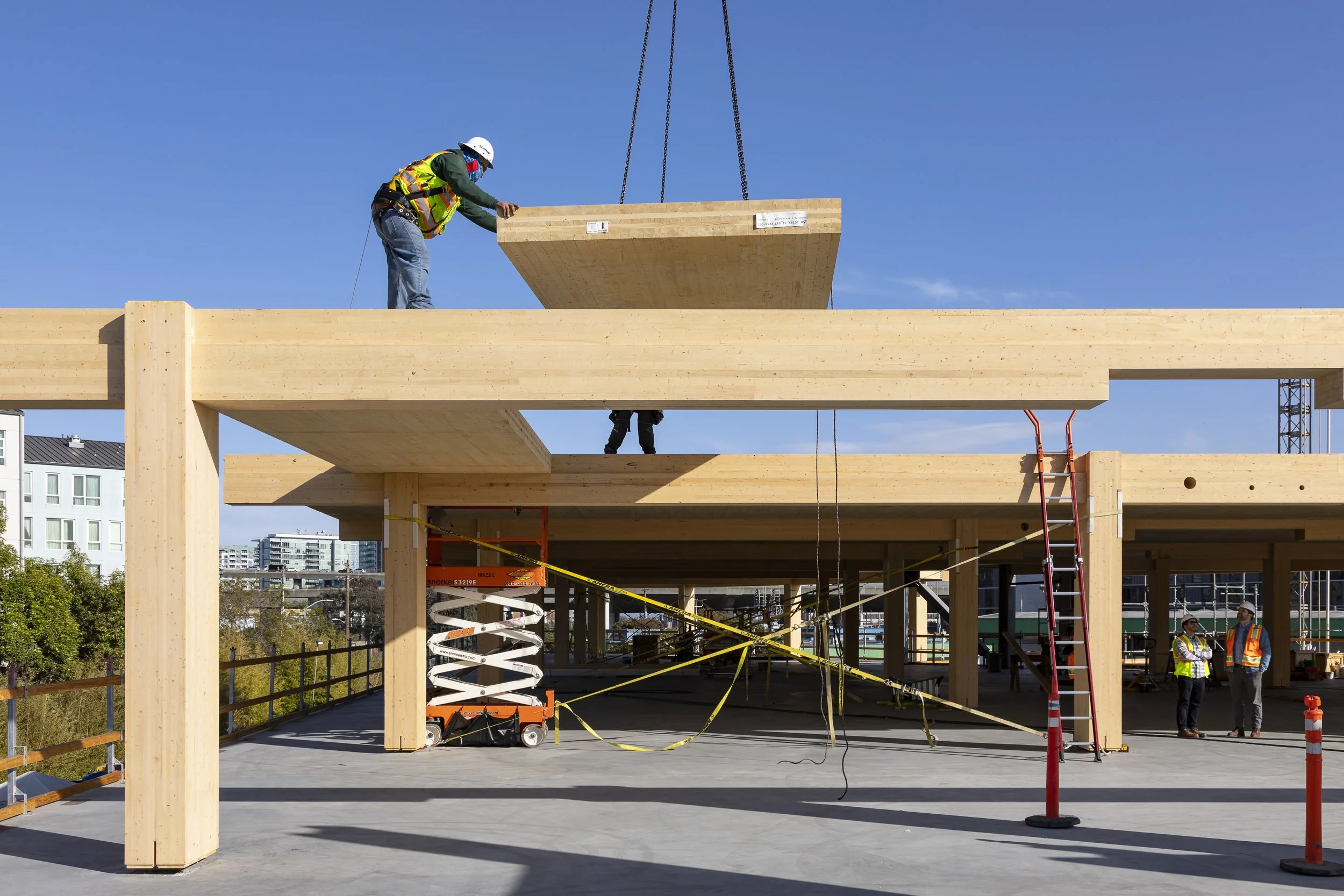
PANELS of mass timber are used to build 1 De Haro Street in January 2020. | Photo: Kyle Jeffers
Hearing From the City and the Unions
Mass timber is still relatively uncommon in San Francisco. The SF Department of Building Inspection (DBI) does not specifically track mass timber projects. The City is directly involved with one project regarding the material: the $3 billion-plus in upgrades for the Southeast Treatment Plant, the City’s largest wastewater treatment facility, located at 750 Phelps Street.
“As these projects become more commonplace, we will train our staff on how to evaluate them to ensure compliance with the California Building Code,” said DBI Communications Director Patrick Hannan.
DBI currently uses expert third-party engineering peer review on all mass timber projects. It relies on performance standards in the state building codes to ensure structures made of any approved material are safe.
Cement masons have relatively little involvement with mass timber or hybrid buildings, aside from pouring the concrete for building foundations.
“The people building the structure leave open the areas where I-beams are set in the bolts,” explained Walter Orellana, business agent for Plasterers and Cement Masons Local 300. “There’s clearance between the bolts and the slab of the foundation. The bottom of the beams are grouted in with non-shrinkable materials. After they set the I-beams, we come and pour concrete to complete the slab.”
Ironworkers play a larger role in installing the material. General contractors, owners, and developers have increasingly selected them for jobs with the material over the past decade.
“Large tech companies like the aesthetic of mass timber, even though some don’t like to publicize their structures much,” said Eddie Reyes, president of Ironworkers Local 377. “You often see mass timber enclosed in glass.”
In the Bay Area, ironworkers are seeing more interest in hybrid buildings rather than the all-wood structures that are commonplace in the Pacific Northwest.
“These jobs involve installing quite a bit of [rebar] and structural concrete,” Reyes said. “The mass timber producers protect the wood by shipping it out covered in plastic sheets. But ultimately, indoors, they want the material to be seen.”
Mass timber floors are laminated. They must be screwed down using thousands of screws.
Currently, small- to medium-sized steel erection firms are more interested in mass timber than larger general contractors that employ ironworkers.
“It’s difficult to convince companies to move out of their comfort zone,” Reyes said. “The bigger contractors are happy in their box.”
Since 2018, when the first mass timber building started construction in San Francisco, the ironworkers have become one of the mass timber industry’s most important partners.
“We’ve done multiple Q&A events in the San Francisco Bay Area for the ironworkers and their contractors,” said President Tom Baun of Three Tree Consulting, a Colville, WA-based firm serving the construction industry. “We’ve built direct, collaborative relationships between mass timber manufacturers, vendors, and ironworker contractors actively engaged in mass timber construction. These connections have strengthened trust, aligned expertise, and created meaningful opportunities that position projects to cross the finish line successfully.”
Ironworkers are the preferred installers of mass timber because they’re experienced in the rigging, setting, installation, and logistics of all structural components.
“The mass timber industry wants partners who can install this material in a safe and efficient manner, keeping the budget and schedule as top priority,” Baun said. “California was the first state where ironworkers were trained through the Ironworkers Training Program with mass timber mockups. The 8' × 8' × 10' mockup provided real-world, hands-on experience.”
A History of Interaction
“A mass timber building can be built up to 25% faster. That really threw people.”
WoodWorks, a Washington, D.C.-based industry association with regional offices throughout the country, plays a significant role in encouraging the use of mass timber.
The nonprofit provides education and free technical support related to the design, engineering, and construction of commercial and multi-family wood buildings in the U.S. WoodWorks counts architects, structural engineers, and construction experts among its staff. These professionals assist with all aspects of wood building design, including projects that involve mass timber.
WoodWorks was established in 2007. Ethan Martin, who served as the organization’s Northwest regional director from 2011 to 2020, was among the first officers to reach out to the ironworkers. He’s now director of projects for Generate, a nationwide mass timber design-assist firm.
“In the beginning, so many people were concerned about fire,” Martin said. “They thought mass timber meant light-frame timber that would easily catch on fire. They were worried that a wooden structure with a fire protection system not yet installed would burn down. We had to teach people that mass timber doesn’t catch fire in the same manner.”
Another point that Martin has to help clarify is just how quickly mass timber construction can occur.
“A mass timber building can be built up to 25% faster,” he said. “That really threw people.”
Martin also explained that mass timber is cut very precisely — within a 2 millimeter tolerance. This can be an issue because concrete cores have allowable tolerances much larger than 2 mm.
“There are times we’ve had to take a chainsaw to the timber to allow for the intolerances of other materials,” Martin said. “If other material is several inches out of plumb, the mass timber element is much more precise.”
Chelsea Drenick is WoodWorks’ regional director for Northern California, Nevada, and Utah. She held 30 in-person “Lunch ’n’ Learn” sessions in the Bay Area last year, as well as numerous virtual events.
The envelope, or curtain wall, she said, has been a popular topic. The terms refer to the non-structural exterior covering for the building.
“Since you need to protect the wood from the elements, we discuss different options for doing that,” Drenick said.
As the demand for mass timber grows, especially in the Bay Area, builders are looking for materials that can be delivered quickly. They’re hoping for minimal shipping costs, no tariffs, and a small carbon footprint.
Part of the reason for the interest in mass timber is the implementation of Assembly Bill 2446, legislation that Gov. Gavin Newsom signed in 2022. The law requires the California Air Resources Board to develop a framework to reduce the average carbon intensity of materials used in the construction of new buildings. The state is seeking to achieve a 40% net reduction in greenhouse gas emissions of building materials by 2030.
Mass timber will be critical to meeting this goal, said the Fabric Mass Timber preconstruction director Mark Little. Of the mass timber factory near Redding that his firm is currently building, he said it’ll be capable of sourcing lumber close to the factory.
“There’s no shortage of wood in California,” Little said. “This factory will be near mills, Interstate 5, and the Redding Regional Airport.”
The factory will create products from industry-standard wood species, as well as from underutilized wood species that are typically sourced from wildfire mitigation thinning projects.
“Douglas fir is the most commonly used species for mass timber in the Western U.S. and Canada,” Little said. “It’ll be used to create glued laminated timber [a.k.a. glulam] beams and columns.”
Glulam is made by gluing layers of wood together with a moisture-resistant adhesive. The wood grain in a layer has to run parallel to the length of the wood.
The Fabric Mass Timber factory will use spruce-pine-fir as well as Douglas fir to make cross-laminated timber (CLT), whose panels for walls and floors are made by gluing together at least three layers of lumber at angles perpendicular to one another.
A Look Back
The SF design firm Perkins and Will’s Matt Covall helped design the first mass timber building in San Francisco, 1 De Haro Street. The all-mass-timber building comprises 130,000 square feet of office space and stands four stories tall. This structure remains a showpiece for mass timber construction, particularly CLT.
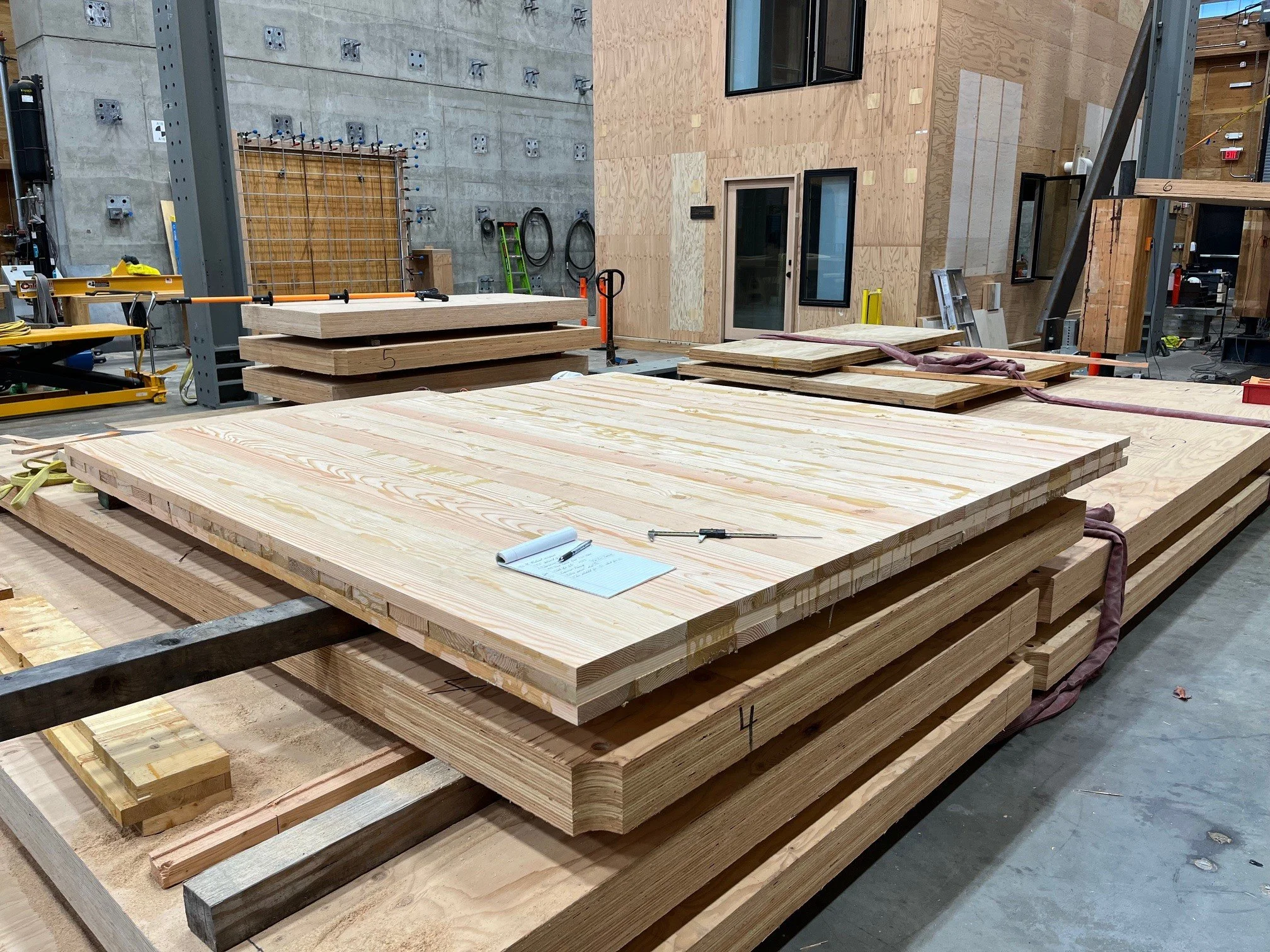
A NEW MASS TIMBER PANEL from Oregon’s TallWood Design Institute sits finished. | Photo: Mark Little
“It was done as a spec project,” Covall said. “The developer started the process without a lease.”
One De Haro now serves as the headquarters for Samsara, a software development company.
“I think they were particularly drawn to the sustainable narrative that goes along with mass timber,” Covall said.
The building’s foundation pour, he said, was 50% lighter than normal.
“Still, in San Francisco, how big the foundation is depends on where the building is located,” Covall said. “This is at the edge of the mud flats in the City — it’s old Bay fill. One of the things that allowed the project to pencil was that this was a much lighter building than a concrete structure.”
One De Haro has a glass facade. At night, Covall said, it looks like a “jewel box.”
“It just glows. You can highlight and show off that wood,” he said.
The builder of 1 De Haro was Hathaway Dinwiddie, headquartered in San Francisco. Covall recalled that the project required work during a particularly wet winter.
“We had to tape up all the seams between the panels of wood,” he said. “We didn’t want water to fall between the panels. Even with this effort, workers were out there squeegeeing the wood.”
Wood can get wet, but the water doesn’t seep in so long as it’s removed. It helped that the fabricator had applied special coatings to the material, as recommended by a waterproofing consultant.
The lessons that Perkins and Will learned led to the firm designing multiple mass timber structures to be sited within the Bay Area. Perkins and Will is also currently designing a mass timber expansion in the Mission District for Oberlin Dance Collective.
“This additional space will be all mass timber,” Covall said. “It’ll contain a black-box theater and administrative offices.”
He would still like to see more mass timber buildings being built in San Francisco and the Bay Area.
“There was a lot of interest and momentum around mass timber between 2017 and 2019,” Covall said. “That enthusiasm cooled during the early part of the pandemic, largely because new construction shifted toward lab buildings rather than offices. I expect mass timber to play a major role in future office building and housing.”