
Proof of Concept
One current project provides a test case in how SF’s transfer tax could be modified for the better

San Francisco’s Proposition I tax was sold in 2020 as a way to make the biggest real estate deals pay more and fund affordable housing. Now, with construction stalled and jobs on the line, the building trades, developers, and City Hall are pushing to roll it back. This is the second article in a series digging into the City’s transfer tax.
When San Francisco’s Proposition I raised the transfer tax on property worth more than $25 million from 3% to 6%, it was heralded as a way to make the biggest real estate dealmakers pay more to help fund affordable housing. Now, with construction stalled and jobs on the line, the building trades, developers, and City Hall are pushing to roll it back.
San Francisco’s transfer tax debate centers on whether — or to what extent — the City’s 2020 doubling of the tax on large real estate transactions has effectively frozen development. Critics say that the higher tax has made major projects harder to finance and slowed construction activity. Supporters claim it was a way to generate revenue from high-value property deals.
A potential proof of concept is already taking shape, as supporters of transfer tax reform point out how a large-scale development can pencil out under a modified tax structure. At the same time, the building trades are taking a methodical approach to rebuilding the pipeline.
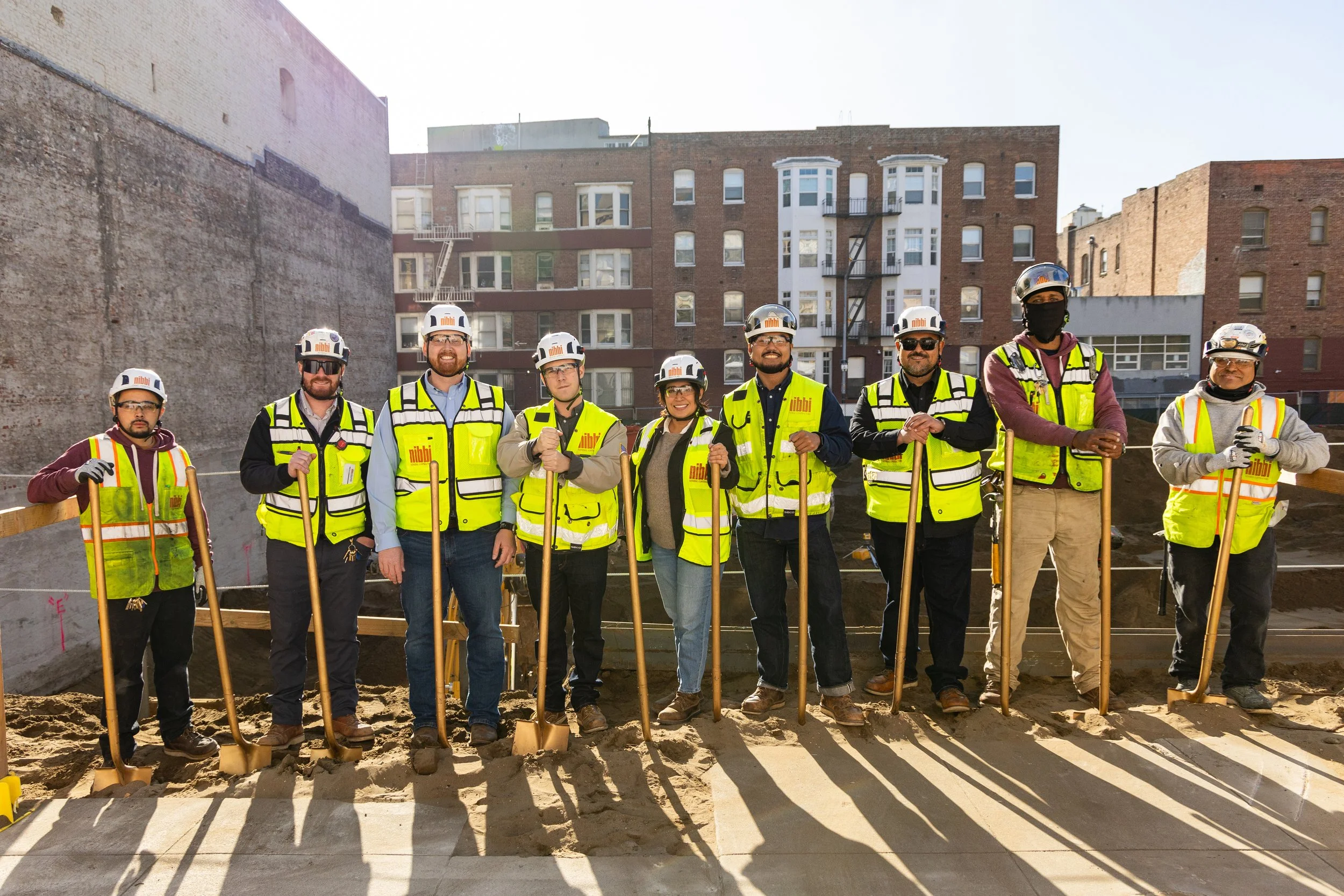
Trades workers and Nibbi Bros. Construction staff gather for a photo op at the 1111 Sutter Street project groundbreaking late last year. | Photo: Jana Ašenbrennerová
Proof of Concept: 1111 Sutter Street
The debate over transfer tax reform comes down to a simple question: Can targeted policy changes help restart housing production in one of the toughest financing environments San Francisco has ever faced?
The 1111 Sutter Street project just might present enough evidence of how projects can move when transfer tax relief is paired with strong labor standards and union-backed capital. A mixed-income housing development rising in San Francisco’s Lower Nob Hill and Lower Polk corridor, 1111 Sutter is a 22-story tower set to deliver 303 housing units. Roughly one-third of those units will be designated below market rate.
The project’s importance also lies in the financing structure behind it. In October 2024, San Francisco enacted a targeted transfer tax reduction for qualifying residential rental properties valued at $10 million or more. To qualify, projects must include at least 12% affordable housing, be built with union labor, and secure at least $25 million in debt or equity financing from a union pension fund.
The Sutter project checked all the boxes: built entirely with union labor, financed (in part) through $180 million from the AFL–CIO Housing Investment Trust, and nearly a third of the units marked as affordable. Therefore, 1111 Sutter met the standard for the City’s reduced transfer tax structure.
Ted Chandler, a former AFL–CIO Housing Investment Trust executive now consulting with the trust, pointed to 1111 Sutter as an example of targeted tax policy aiding stalled projects. He said the development will add hundreds of units, including over 100 affordable homes, at a time when large-scale construction is slow.
Chandler emphasized that the 2024 legislation shows its effectiveness through projects like 1111 Sutter, which transformed an old parking garage and car dealership into new homes and union jobs. It also drives economic activity while boosting tax revenue, he said.
“We’re making our largest investment in the history of the Housing Investment Trust — in our more-than-40-year history,” Chandler said. “I think that’s a demonstration of how successful this kind of policy — providing this kind of tax relief — can be.”
Mathing the Math
While tax policy details can be complex, the key issue in San Francisco’s transfer tax debate is clear: raising the tax rate makes large-scale projects harder to finance, discouraging developers, lenders, and investors. On the other hand, lowering the rate encourages these projects but can decrease the City’s immediate revenue.
Oz Erickson, principal and chairman of developer Emerald Fund, explained that large housing projects face tighter finances than many realize. When pension funds provide construction financing, developers must contribute about 25% of the total project cost as equity and maintain profit margins of roughly 20% to satisfy lenders and investors. Reducing transfer taxes lowers a significant transaction cost, improving project viability and profitability.
“Something like this moves the needle in terms of the ability to start construction,” Erickson said. “You are reducing a major cost.”
When Prop I passed in 2020, the San Francisco controller estimated that the measure could generate nearly $200 million in additional transfer tax revenue annually. In the years following its passage, the tax produced hundreds of millions of dollars for the City as real estate activity surged. Transfer tax collections peaked at roughly $520 million in fiscal year 2021–’22 before falling sharply. By fiscal year 2023–’24, total transfer tax revenue had declined to approximately $178 million, nearing a 12-year low.
Reducing San Francisco’s transfer tax from 6% to 3% would almost certainly reduce revenue on any individual qualifying transaction in the short term.
This ongoing debate about the transfer tax is playing out against an even broader fiscal challenge for City Hall. San Francisco is facing a two-year budget shortfall of more than $640 million. The larger policy argument is that the City may collect more revenue overall if lower taxes help restart stalled development activity.
A project generating no transfer tax because it never gets financed or built produces zero revenue — along with zero construction jobs, zero property tax growth, zero sales tax activity from residents, and zero long-term economic spillover.
At the same time, city officials are exploring ways to capture revenue that might be falling through the cracks. A proposal by SF Assessor–Recorder Joaquin Torres would close a loophole involving foreclosures and “deed in lieu” transactions, in which distressed properties are voluntarily handed back to lenders. Under the current system, these transfers can sometimes be recorded at little or no value, allowing ownership to change hands while generating minimal transfer tax revenue.
A change could potentially make an overall reform package budget-neutral — or even revenue-positive.
“As administrators of the tax, the public and policy makers are relying on my office to raise issues like this one to ensure the policies on the books make sense for San Francisco today,” Torres said in a statement to Organized Labor. “Fair and accurate taxes are our goal, and exemptions like this need to be reviewed and considered openly, in daylight.”
Measure Twice, Cut Once
San Francisco Building and Construction Trades Council Secretary–Treasurer Rudy Gonzalez said he has intentionally taken a slow, methodical approach to transfer tax reform.
“These are not just investments,” he said. “These are careers. These are people’s families and lives.”
Gonzalez hopes for a reduction in the transfer tax rate paired with offsetting revenue measures and dedicated affordable housing funding. The broader goal, he argued, is to trade a volatile and increasingly unreliable revenue source for more durable long-term economic activity generated through construction.
Gonzalez described the negotiations as delicate, unfolding amid budget issues, election-year politics, and competing interests at City Hall. He said the building trades remain focused on finding a policy solution that is not just economically sound but politically achievable.
“While I would have liked to have moved more aggressively and faster, we are doing what we always do,” Gonzalez said. “We’re going to do it right the first time.”