
Playing With Fire
Forces aim to water down sprinkler ordinance, sparking dispute, while labor pushes back
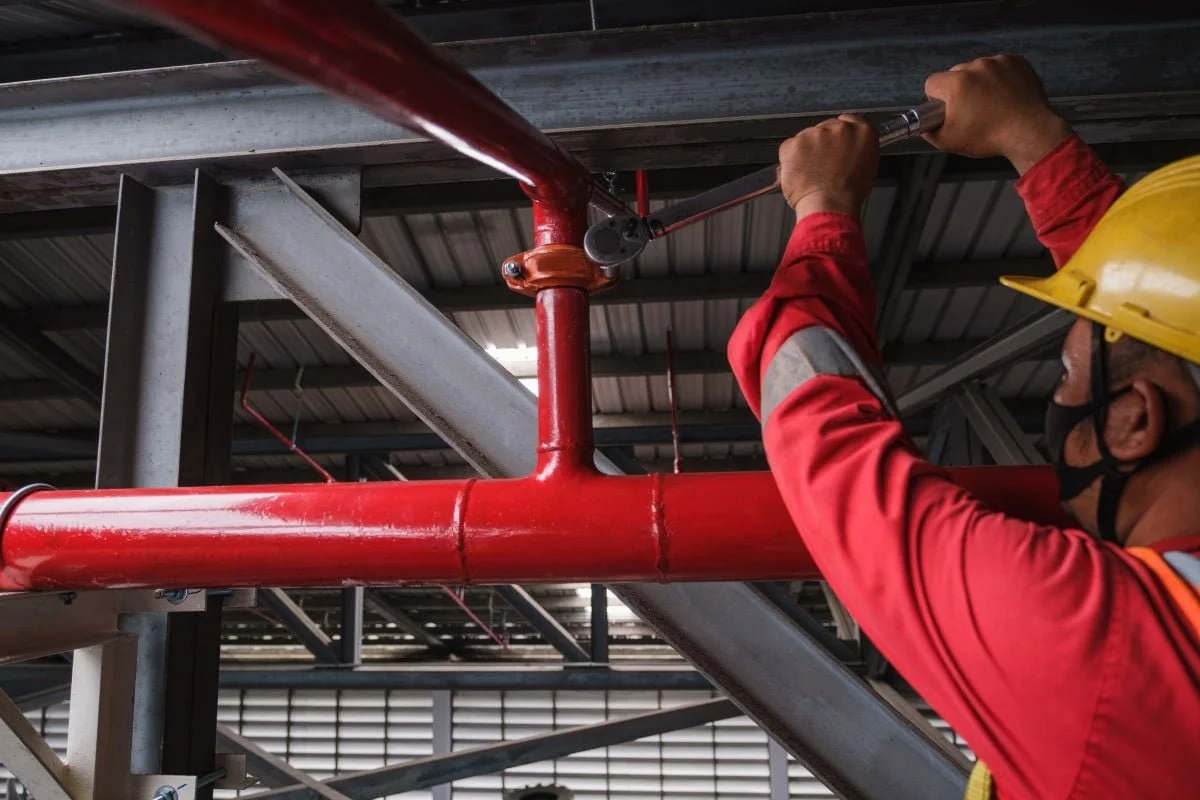
FIRE SAFETY ADVOCATES argue that the implementation of San Francisco’s sprinkler retrofit requirement should neither be delayed nor diluted, lest public safety be jeapordized.
San Francisco’s long-planned effort to retrofit residential high-rise buildings built before 1975 with modern fire sprinkler systems is facing renewed political pressure, as luxury condominium owners push city officials to amend a fire safety law adopted just three years ago.
Labor leaders and fire safety advocates say the attempt to revise the ordinance is being driven by fear-based messaging and is being negotiated behind closed doors, excluding renters, firefighters, and the skilled trades members who would perform the work.
“This law exists, and it’s there to protect lives,” said Rudy Gonzalez, secretary–treasurer of the San Francisco Building and Construction Trades Council.
Spin City
San Francisco adopted the fire code amendment in 2022 after it passed through the Fire Commission and the full Board of Supervisors, part of a routine update to maintain compliance with national, state, and local fire safety standards.
The law established a 12-year implementation timeline. The phased approach allowed an on-ramp for inventory, notification, education, design, financing, and construction.
But a coalition of condominium owners — many from luxury waterfront and high-rise buildings — organized through homeowners associations and hired a professional lobbyist to press for changes. Their argument centers on cost and potential displacement during construction.
Gonzalez said the cost estimates circulating among opponents are significantly inflated and not supported by industry analysis. He argued that fear has been amplified through lobbying rather than informed discussion.
“I think people are lobbying their supervisors because they believe this is going to displace them,” he said, “and I think it’s unfortunate that policymakers haven’t seen this as more of an educational opportunity.”
Cost and Displacement Concerns
“Life safety should be the absolute first, second, and third priority.”
Opposition to the ordinance has largely centered on cost, with some estimates circulating that retrofitting a single condominium unit could run as much as $300,000.
Sprinkler Fitters Local 483 Business Agent Brandon Bracamonte said those figures are wildly inaccurate and that retrofitting would likely cost just a fraction of that amount.
Bracamonte said he understands that elderly homeowners on fixed incomes are alarmed when confronted with six-figure estimates, but argued that those numbers do not reflect the actual cost of sprinkler systems.
Dan Torres is a general foreman and member of Local 483 who is a former trustee of the SF Building Trades Council. At the time of the drafting of the ordinance, he was Local 483’s business agent. He said there are affordable ways to retrofit units and that fears of displacement are similarly overstated.
“I have empathy for people who may not have the resources to do this,” Torres said. “Our intent is not to displace anybody.”
Depending on the installation method, he said that sprinkler systems can often be installed in a single day, with residents returning to their units the same night. Additional testing might require brief follow-up visits, but not long-term relocation.
Both Torres and Bracamonte cited projects where retrofits were completed with little or no displacement.
“Homeowners are scared that you’re going to have to rip open their walls, you have to rip open their ceilings,” Torres said. “It’s ridiculous what these people are saying.”
Safety Is Job One
Gonzalez said the debate has drifted away from the central issue: fire and life safety.
“Life safety should be the absolute first, second, and third priority,” he said.
Fire officials and labor representatives have pointed to decades of evidence showing that sprinkler systems dramatically reduce fatalities, injuries, and large-scale displacement during residential fires.
Gonzalez cited San Francisco’s 2016 expansion of sprinkler requirements to single-room-occupancy hotels, a move firefighters credit with sharply reducing multi-alarm fires and mass displacement.
Beyond life safety, sprinklers reduce housing loss after fires. A one- or two-unit disaster could turn into a multi-floor tragedy.
“The whole reason we want to get it done sooner than later is so we don’t possibly lose a life,” Gonzalez said.
What About Renters?
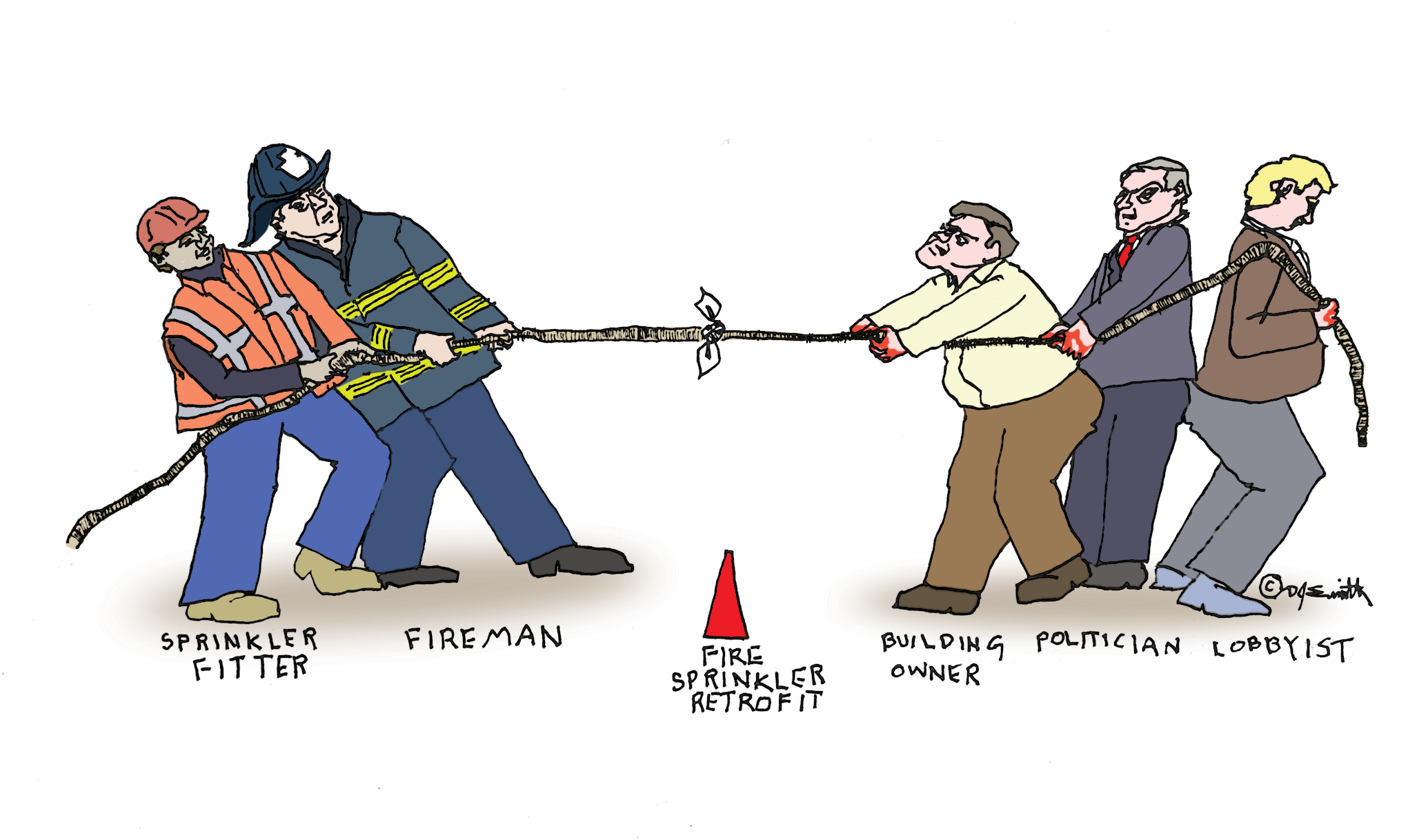
Illustration: David James Smith
While condominium owners have organized and lobbied city officials, Gonzalez said renters have been almost entirely absent from the discussion. He stressed that renters deserve representation in decisions affecting their safety and housing stability. He also argued that sprinkler retrofits are a tenant-protection issue — not just a building-cost issue.
Local 483 Business Agent Bracamonte also raised concerns about renters, who often have no voice in decisions made by building owners.
“What about the people who rent in those buildings, who don’t have a say and would like the fire protection?” he asked.
Ill Communication
Gonzalez said the most troubling aspect of the current debate — aside from safety issues — is how proposed changes are being developed.
For months, the mayor’s office, the fire department, and certain members of the Board of Supervisors have been negotiating amendments to the fire code without consulting firefighters, sprinkler fitters, specialty contractors, or tenant advocates, Gonzalez said.
“We are very concerned that they’re doing this in a vacuum,” he said. “I think they’re dealing with conjecture, emotions, and, at worst, erroneous information — and, at best, purposefully misinformed propaganda.”
When the law was initially crafted, Gonzalez said, then-supervisor Aaron Peskin convened labor, fire officials, and industry experts and required detailed cost modeling before advancing the legislation.
“So, they did all of this homework on the front end, and a couple of Johnny-come-latelys have now listened to lobbyists without talking to the experts who passed the law the first time,” Gonzalez said.
Rather than rushing changes, he called for a pause, and for the creation of a technical advisory committee bringing together renters, condo owners, firefighters, labor representatives, and contractors.
Local 483 member Torres agreed and described the effort as a unilateral attempt to revise the law without consulting labor, industry experts, or housing representatives.
Delays, Gonzalez warned, could ultimately increase costs, as labor, materials, and financing become more expensive over time.
What Comes Next
San Francisco’s fire code is amended on a three-year cycle. Discussions about possible changes could culminate in a decision early next year. Fire safety advocates hope the ordinance remains intact, Torres said.
Meanwhile, labor groups and fire safety organizations are working to counter misinformation. Torres said advocates are developing a campaign to explain retrofit options, realistic costs, and how owners can engage qualified contractors.
“There are a lot of myths […] out there, and I feel like we could have answered a lot of these questions,” Bracamonte said. “We’re just trying to get the proper information out to people.”
After all, the City, he said, is not breaking new ground.
“San Francisco is not changing the national standard — we’re just trying to get up-to-date with the national standard.”