
Midterm Mania
SF Building Trades, Labor Council outline essential candidates and ballot measures ahead of November’s general election
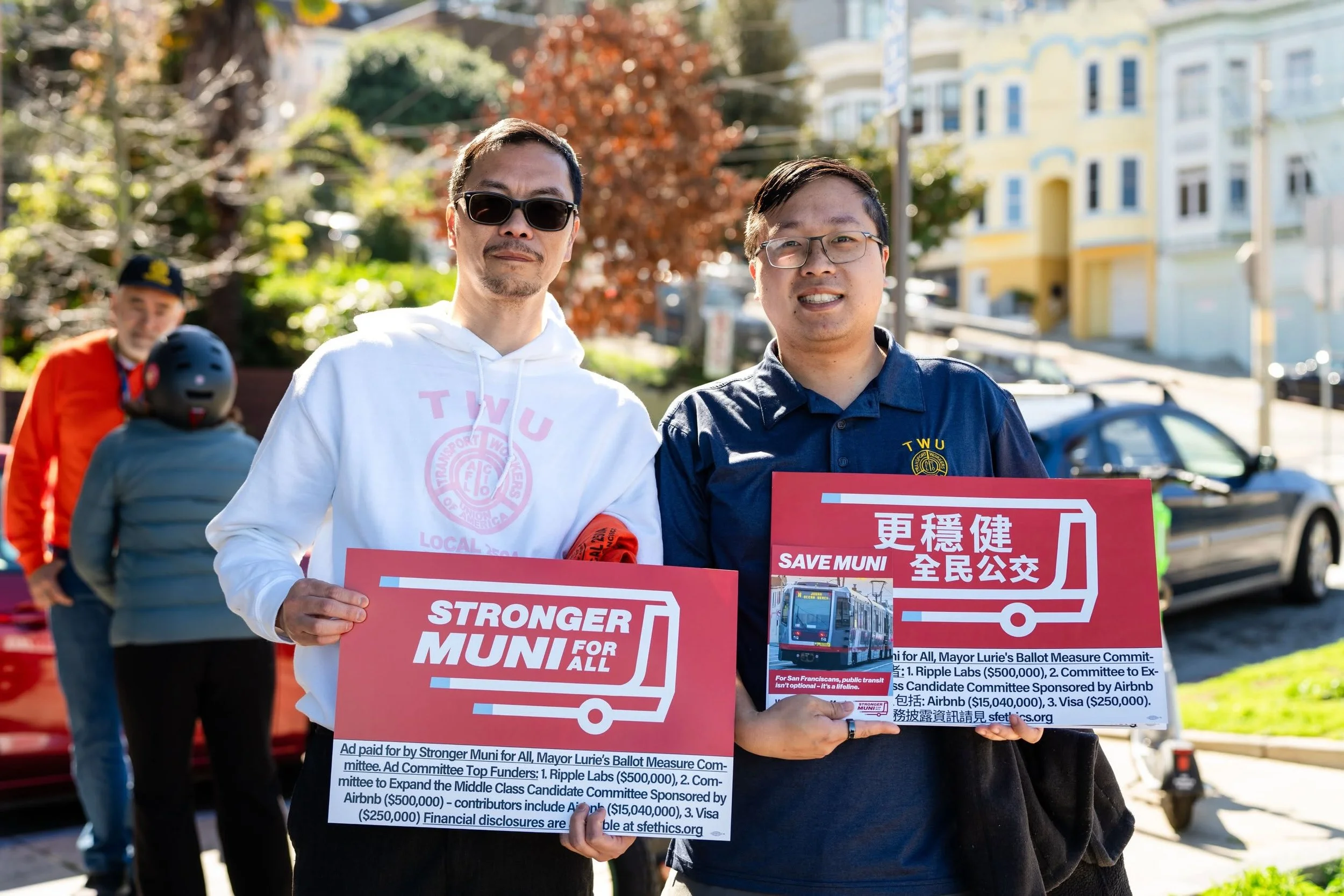
MEMBERS of Transit Workers Union Local 250A campaign for Prop H — the Stronger Muni for All measure — earlier this month. | Photo: Stronger Muni for All
The November 3 general election is a little over a month away. San Francisco will begin mailing ballots on Monday, October 5, and most of them should reach voters within a week. Early in-person voting also begins on October 5 at City Hall, a full 29 days before Election Day.
In anticipation of this highly consequential race, Organized Labor spoke with SF Building and Construction Trades Council President Larry Mazzola Jr. and SF Labor Council Political Director Rosa Shields about their organizations’ electoral priorities this fall. These include transit funding and, for the first time in nearly 40 years, a new congressperson representing the City.
Mazzola said that his council’s endorsements are recommendations based solely on the interests of the building trades, regardless of party affiliation. Its focus, he said, is on which candidates and ballot measures will create jobs and help union members maintain their wages, health benefits, and pensions.
“We did the homework, and here’s what is best for labor,” he said.
The Measures
For starters, the trades strongly oppose Proposition I, which would redirect about $120 million annually in real estate transfer tax revenue from the City’s general fund to affordable housing programs. Critics, including Mayor Daniel Lurie, warn that it would deepen San Francisco’s budget deficit.
“It takes money out of the general fund and gives it to nonprofits,” Mazzola said of Prop I. “That’s a big one for us.”
The SF Labor Council has not taken a position on Prop I.
The Labor and Building Trades councils are in lockstep, however, in supporting Prop H and the Regional Transit Measure.

Photo: Stronger Muni for All
Prop H, otherwise known as Stronger Muni for All, would impose a 15-year parcel tax expected to raise about $160 million annually. The money would help close Muni’s projected deficit of more than $300 million and prevent major service cuts.
The Regional Transit Measure would raise about $980 million annually for BART, Muni, Caltrain and other transit systems.
Mazzola fears both measures’ failure could lead to significant job losses.
“The Muni one is a big deal,” he said. “If that doesn’t pass, maybe they’re looking at layoffs. It’s going to be dire straits for Muni if they don’t get that bond passed.”
Shields warned that Muni and BART could face draconian cuts that would hurt not only members of SEIU Local 1021 and the Transport Workers Union locals 200 and 250A but working people throughout the region who rely on public transportation to get to their jobs and back home every day.
“Our transit unions — public-sector unions — are very concerned about transit’s fiscal cliff,” Shields said. “We want to protect public services. Our workers need to get around. Not just the transit unions, but all workers need to be able to take Muni [and] BART. The pandemic had serious effects on funding for Muni and BART. There’s a lot of revenue lost, and these measures are going to help make that up.”
The SF Labor Council also opposes Prop D, which would make it more difficult for residents and organizations to place measures on the ballot.
“We see it as very undemocratic, and it’s just going to make it way more expensive for unions and our members to get anything on the ballot,” Shields said.
“Proposition D threatens to diminish worker voices and concentrate power in a way that could lead to less transparency and accountability,” said SF Labor Council Executive Director Kim Tavaglione in a press release. “We believe this measure is not in the best interest of San Francisco’s working families and the broader community.”
The trades have not taken a position on Prop D.
Both the SF Labor Council and the SF Building Trades Council support Prop J, which would end a transfer tax break for those who take ownership of larger properties through foreclosure.
In Sacramento, the State Building and Construction Trades Council of California is leading the opposition to Prop 45, which would weaken CEQA and community safeguards without adequately protecting workers.
The Candidates
The enthusiasm for Connie Chan is palpable, as she vies with Scott Wiener.
SF District 1 Supervisor Chan is running to fill the 11th congressional district seat currently held by Nancy Pelosi, who is retiring after nearly 40 years in the House of Representatives.
“The Labor Council and our affiliated unions are all-hands-on-deck focused on electing Connie Chan to Congress in November,” Shields said. “That’s our main priority.”
Shields said Chan could follow in Pelosi’s footsteps while making history as the first Asian-American to represent San Francisco in Congress. She described Chan as someone who understands the needs of working families and who has consistently supported organized labor.
In the race for SF supervisor in District 10, the trades endorsed three candidates, in ranked order: Theo Ellington first, J.R. Eppler second, and D.J. Brookter third.
“The bottom line is that all three of those candidates will probably be pretty good for the building trades,” Mazzola said.
Both the SF Building Trades and the SF Labor Council endorsed Gary McCoy in District 8.
Shields described the upcoming election as a pivotal moment for San Francisco amid a worsening housing and affordability crisis.
“It is about unions and working people versus the millionaire and billionaire class in every race and every measure — that’s what we’re seeing,” she said. “I think this is a critical moment for our city.”