
First Contracts, Strange Bedfellows, and a ‘Marathon in a Minefield’
Is the passage of the Faster Labor Contracts Act a win?
The Faster Labor Contracts Act (FLCA), which passed the U.S. House of Representatives in a bipartisan vote earlier this month, promises to speed up the time from a union’s initial organizing to securing its first contract.
While the act addresses a glaring problem in labor law and is by most measures a victory for the labor movement, there’s little chance it will become law — and just might end up being another case of right-wing political troublemaking.
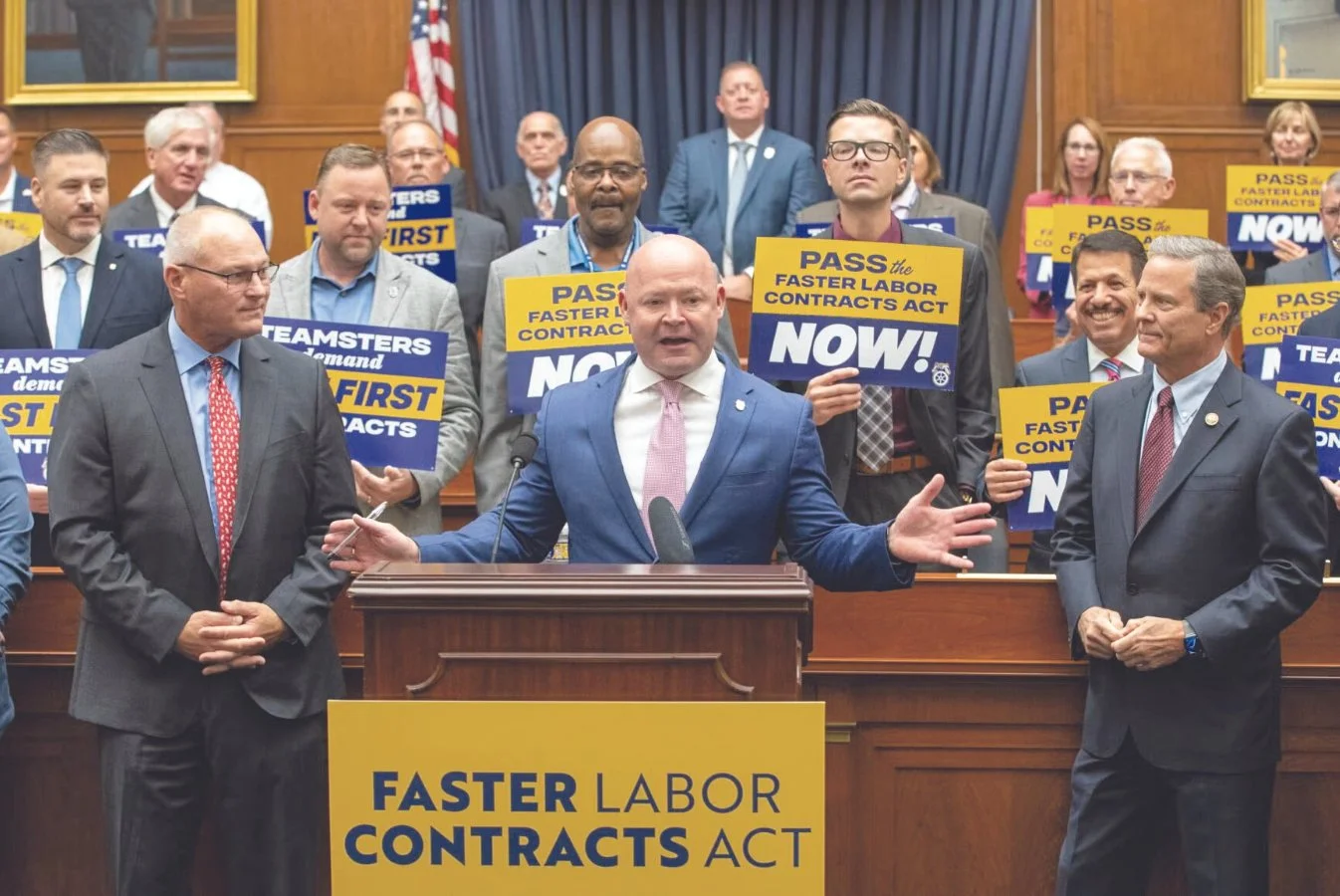
TEAMSTERS General President Sean O’Brien (center, at podium) advocates for the Faster Labor Contracts Act in Washington, D.C., last September. | Photo: teamsters.org
Why the Faster Labor Contracts Act?
The FLCA targets an ongoing issue in U.S. labor law: The gap between winning a union election and securing a first contract can take, on average, 458 days.
The problem, said John Logan, a labor historian and professor of labor and employment studies at San Francisco State University, is that even after workers vote to unionize, companies can drag out negotiations indefinitely. Logan called it “a marathon in a minefield” that includes threats of firings, business closures, and overall anti-union pressure.
Logan pointed to union drives at Starbucks, Trader Joe’s, Amazon, and recreational outfitter REI as examples of campaigns that started strong but have ended up leaving many workers without first contracts.
“Why is that?” Logan said. “It’s because the companies are incredibly rich, incredibly powerful, and will do everything possible — lawful or unlawful — in order to avoid signing a first contract.”
Under the FLCA, employers and unions would have to begin bargaining within 10 days. If they fail to reach an agreement within 90 days, the case goes to mediation. If, after 30 days, mediation fails, then the dispute is referred to a three-person arbitration panel.
As Logan explained, when Congress passed the National Labor Relations Act in 1935, its supporters were concerned about whether the Supreme Court would uphold the law. As a result, the legislation required employers to bargain in good faith with a certified union, but it did not require the parties to reach a contract. Instead, the bargaining process was largely left to what Logan described as the “free play of economic forces.”
Because good-faith bargaining can be difficult to define — and because penalties for bad-faith bargaining are often weak — employers have long taken the opportunity to delay or undermine the process.
“[Republicans] don’t want to destroy [unions]. They want to co-opt them.”
Despite gaining 20 Republican votes in the House, Logan sees no chance of the FLCA becoming law.
“The fact that it passed the House is a big deal,” he said. “The Senate has always been the place where labor law reform bills go to die.”
Is This a Win?
Most certainly, from a labor rights perspective, advancing such a bill is a positive.
“Big, greedy corporations like Amazon stall, delay and use aggressive legal tactics to avoid bargaining first contracts with workers who organize,” said Teamsters Local 856 Secretary–Treasurer Peter Finn in a statement to Organized Labor. “This bill fixes that by requiring an employer to bargain a first contract within six months or go to arbitration. It’s a game-changer.”
One of the most curious features of the FLCA is that Sen. Josh Hawley, a Missouri Republican and leading hard-right populist in Congress, is one of its lead sponsors.
Logan cautioned that a faction of the Republican Party is currently making an effort to present itself as genuinely pro-worker and populist when that obviously isn’t the case. While remaining hostile to public-sector unions such as teachers’ unions and government workers’ unions, Republicans might be trying to win over blue-collar private-sector unions.
“They don’t want to destroy them,” Logan said. “They want to co-opt them.”
These dynamics present labor and the left with a dilemma. Yes, the FLCA advances a long-sought labor goal. But labor generally disagrees with the likes of Hawley on issues such as immigration, LGBTQ rights, abortion, and a whole lot more. But a win is a win, and tomorrow’s battles will come in time.
For Republicans who want to claim the mantle of working-class politics, supporting a bill like the FLCA gives them something concrete to point to.
“It can’t just be rhetoric,” Logan said. “You need to have some legislation.”