
Tunnel Vision
Supervisor Sauter’s pitch for the Central Subway extension would mean jobs for the trades. So, who’s paying?
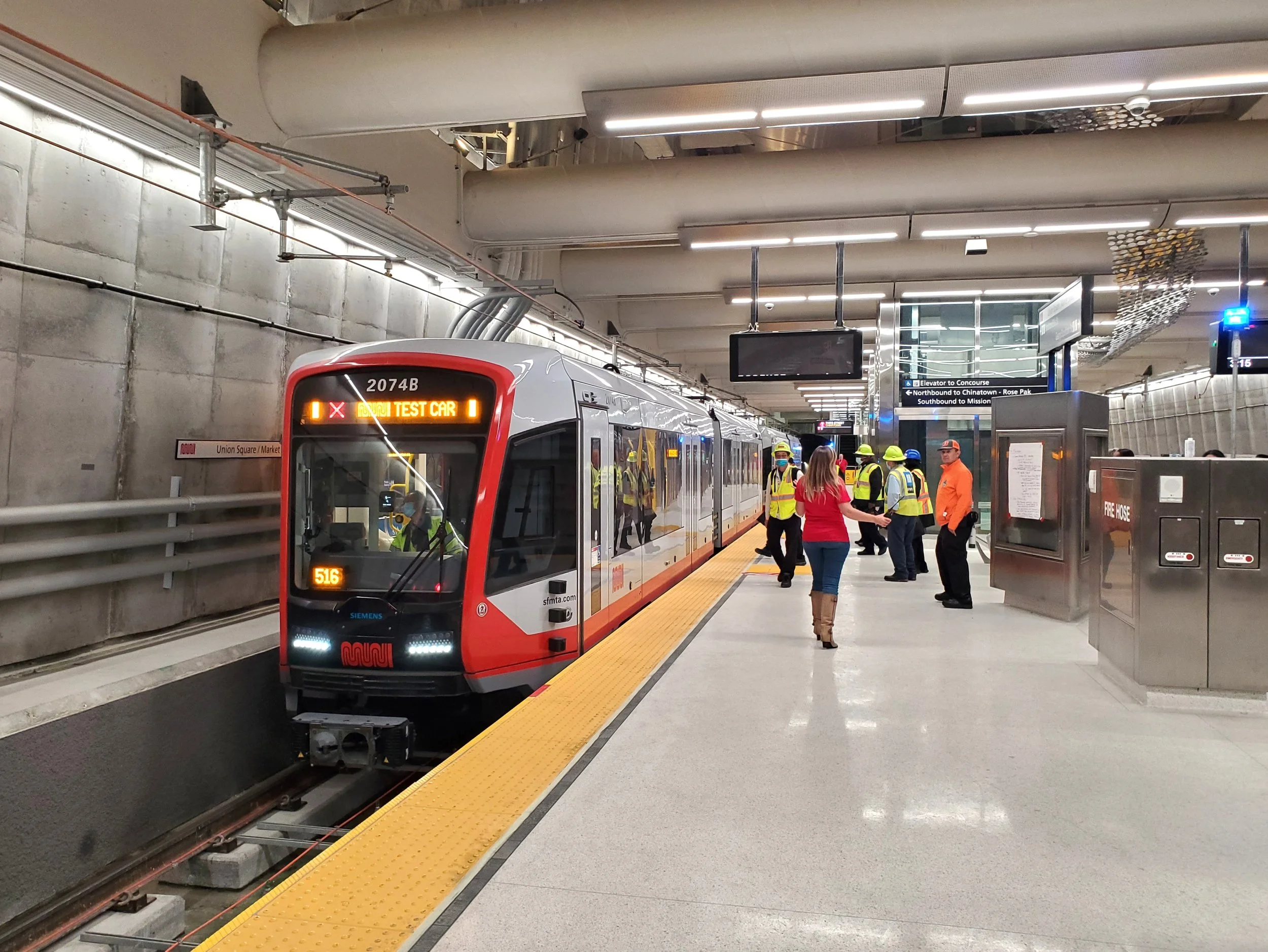
A NORTHBOUND MUNI test train sits at the Union Square/Market Street station during a public viewing event on November 15, 2022, four days before Central Subway service began. | Photo: Pi.1415926535 via Wikicommons
When San Francisco’s Central Subway opened in late 2022, it marked a game-changing moment for transit infrastructure. The long-delayed extension of Muni’s T Third Street line could now drop passengers right into the heart of Chinatown.
Just a few years later, a renewed push is underway to bring the line even farther north.
District 3 Supervisor Danny Sauter is calling for the Central Subway to be extended from its current Chinatown terminus to North Beach and Fisherman’s Wharf, reviving a proposal that has circulated for more than a decade.
“It’s time to get serious about extending the Central Subway to North Beach and Fisherman’s Wharf,” Sauter said in a recent video posted to Instagram. “We know the subway will never reach its full potential until it’s extended. The Central Subway is showing promise, but we know it can be so much more.”
Sauter then convened a hearing before the City’s Land Use and Transportation Committee on the subject.
Will this proposal become a reality? If it does, the building trades are game.
“If they are really serious about it, we guarantee you we will get involved,” said John Doherty, business manager of IBEW Local 6 and a vice-president of the San Francisco Building and Construction Trades Council.
The current Central Subway runs a little over a mile and a half and cost approximately $1.95 billion to build. It takes riders through SoMa, Union Square, and Chinatown. Curiously, the subway already extends partway beyond that final station; a tunnel continues north to Washington Square Park.
Studies dating back to 2015 identified several potential extensions beyond Chinatown. Those concepts included a route along Columbus Avenue and a two-way subway running under Powell Street.
“Everybody gets a ton of work out of it. I think it would be fantastic for the City.”
In 2020, the cost estimate for a one-mile extension hovered around $1.6 billion. That figure could potentially come down if the partially completed tunnel reduces boring needs — or climb higher due to rising construction costs.
Sauter’s renewed push comes at a challenging moment for the San Francisco Municipal Transportation Agency, which is dealing with a significant budget shortfall. In a statement to Organized Labor, the agency trumpeted growing ridership on the T Third line but emphasized that major capital expansions are not currently feasible.
“Ridership on the T Third Line continues to grow, with most of its trips operating through the Central Subway,” the SFMTA statement reads. “We thank Supervisor Sauter for the opportunity to engage in discussions around long-range strategic land use and transportation planning efforts, but in the near term, given our financial situation and the limited funding resources currently available to us, prioritizing cost-effective improvements to existing services and projects remains our top priority.”
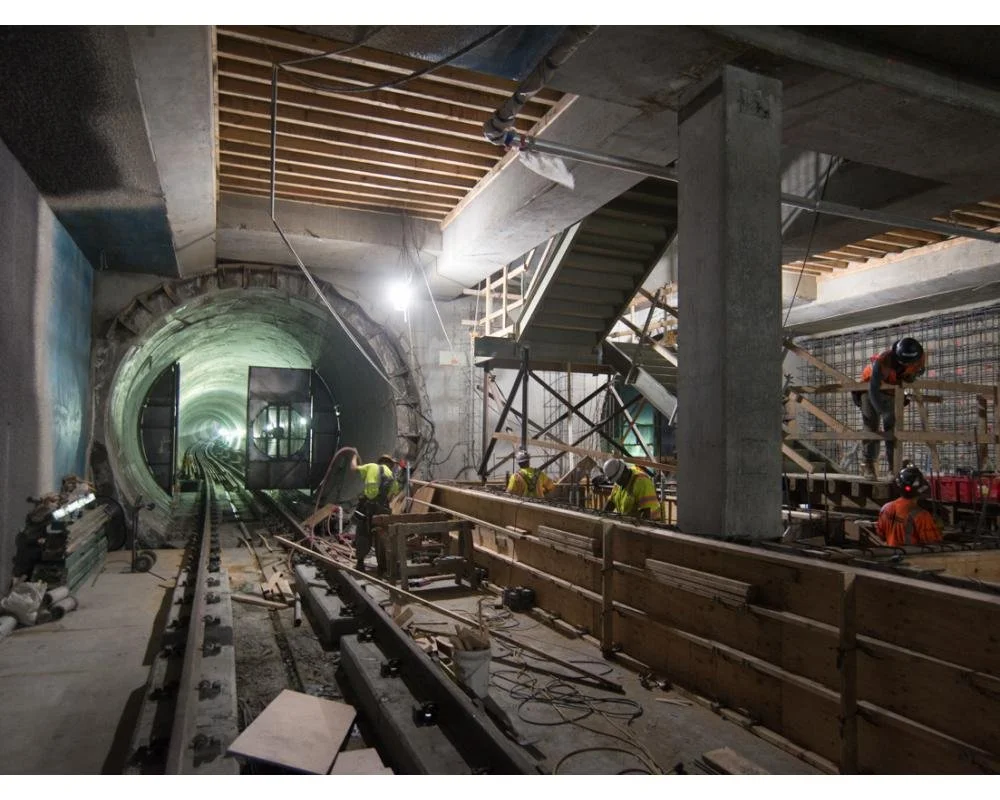
THE CENTRAL SUBWAY is seen under construction in 2018. | Photo: SFMTA
SFMTA officials say the agency faces a $307 million budget shortfall that’s projected to grow to more than $430 million over the next five years.
The 2022 opening of the Central Subway was delayed by several years, raising additional concerns about an extension. Rudy Gonzalez, SF Building Trades Council secretary–treasurer, noted that the Central Subway project lacked a project labor agreement, unlike other major infrastructure projects that have been delivered more efficiently.
“I think the SFMTA has, and could have, benefited from the efficiency and productivity that comes with project stabilization agreements,” Gonzalez said.
For Sauter, the extension is not a surprise. He wrote about the idea in a 2024 op-ed and made transit expansion part of his campaign platform.
Sauter’s office did not respond to a request for comment.
Doherty said the trades have supported a northward extension since the original Central Subway was under construction.
“We were advocating once they had the digger in the ground,” he said. “Whenever it came up, we were advocating for them to take it all the way out to Beach Street and beyond, down to the Wharf.”
Tunnel boring machines aren’t something you pick up from the local hardware store. They’re expensive to operate and difficult to secure.
“It’s a hard machine to get ahold of,” Doherty said. “So, once you have it, don’t give it up.”
A subway extension would generate years of work across multiple trades, from ironworkers and laborers to electricians, plumbers, and tile setters.
“All trades,” Doherty said. “Everybody gets a ton of work out of it.”
He also argued that underground transit offers long-term benefits.
“If you really want to be serious about transit, and you go to other big cities, they have a lot of their transit underground for a reason,” he said. “Or they elevate it.”
An extension of the Central Subway would improve travel times, reduce congestion, and create many union construction jobs.
“I think it would be fantastic for the city,” Doherty said.