
Connie Chan’s defeat capped an election that otherwise delivered wins for transit, affordable housing, and several trades-backed candidates
The November midterms gave San Francisco’s building trades and the broader labor movement plenty to celebrate.
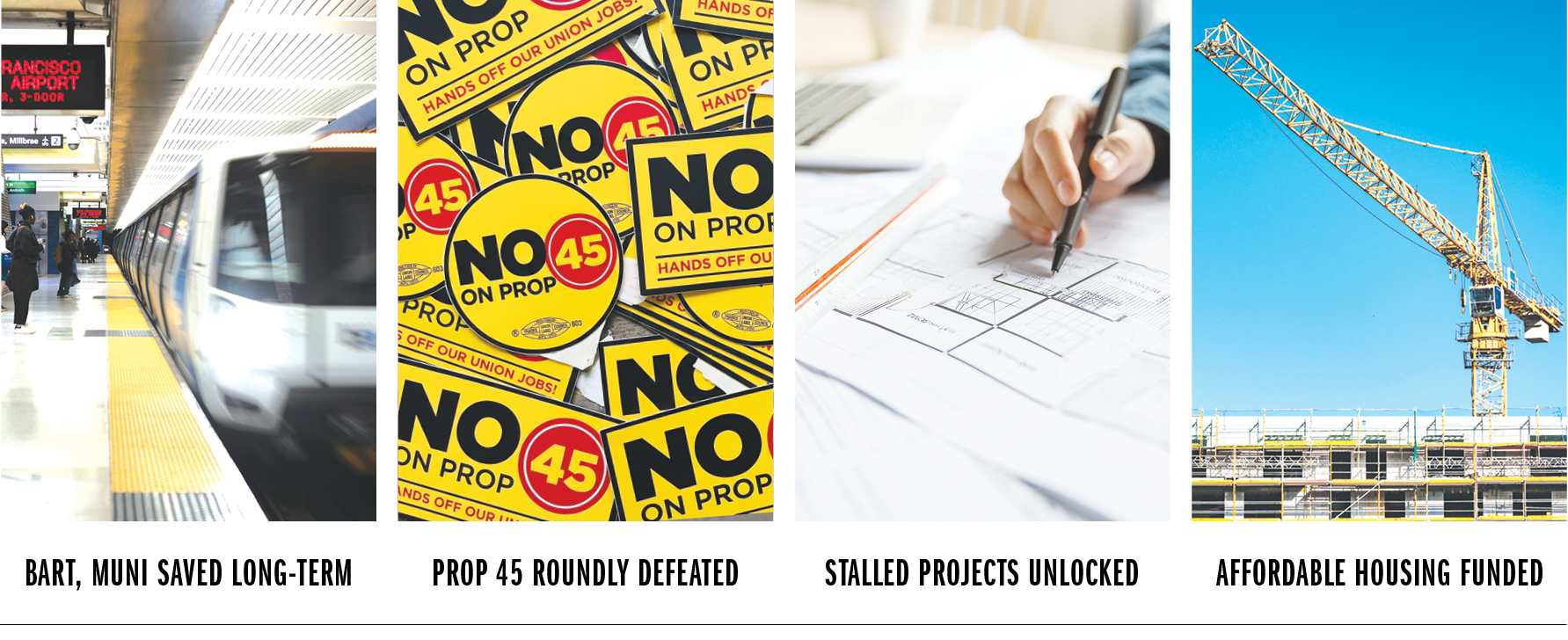
Voters backed measures to fund affordable housing and shore up public transit. They rejected Proposition 45, which would have made it harder for communities to challenge project approvals. Several candidates backed by the building trades won statewide races, and a national “blue-nami” swept Democrats into control of both chambers of Congress, giving them more power to check the Trump administration.
The toughest loss came closer to home. San Francisco Supervisor Connie Chan, the trades’ pick to succeed Nancy Pelosi in California’s 11th Congressional District, fell to state Sen. Scott Wiener. In arguably the council’s most consequential race, that one stung.
Here’s how the building trades fared at the ballot box and what the results could mean for members.
Big Wins
In Northern California, the building trades scored wins on public transit and affordable housing.
San Francisco voters approved Prop H with 74.4% support, creating a parcel tax to fund Muni operations for 15 years. Across the Bay Area, a separate sales tax to support BART and other transit systems passed with 63.2% of the vote. The SF Building Trades Council endorsed both measures.
“Those were huge, and especially for Local 6,” said John Doherty, business manager of IBEW Local 6 and a council vice-president. “We have a lot of members who work at the SFMTA, so you know anything that helps stabilize their funding is important.”
Voters also sided with the building trades on three measures involving housing and taxes. Prop C, which changed how San Francisco contributes to its Housing Trust Fund, passed with 81.7% support. Prop J, which closed a real estate transfer tax loophole involving foreclosures, passed with 80.9% support.
Prop I, which the council opposed, drew 48.3% support. It would have earmarked half the revenue from the transfer tax on high-value properties for affordable housing.
Doherty said building more housing would create jobs for electricians and could help to ease pressure on renters.
“It’s more work opportunities,” he said. “Obviously, there’s a lot of electrical that goes into residential construction, and life-safety systems and what have you. There are good work opportunities that come out of it. Hopefully, anything that gets built that helps reduce the pressure on renting and everything else will help people find more affordable housing and reduce the cost of living in town.”
Statewide, California voters approved Prop 1, a $11.25 billion bond backed by the State Building and Construction Trades Council of California. It sets aside $10 billion for affordable housing and related infrastructure.
Voters rejected Prop 45, which would have sped up environmental review for many projects. Building trades leaders opposed the measure, arguing it would make it more difficult for communities to challenge approvals, give large companies more influence, and reduce local governments’ role in development decisions. They also warned that weak enforcement would make it harder to hold out-of-state contractors accountable for violations.
“Prop 45 was just going to gut our voice in the development process,” Doherty said. “Unfortunately, we can’t trust the development community.”
The building trades also welcomed several statewide victories. Xavier Becerra won the governor’s race, while Malia Cohen won a second term as state controller and Eleni Kounalakis was elected state treasurer. Jane Kim won the race for insurance commissioner.
In San Francisco, Gary McCoy won the race for District 8 supervisor. Mike McGuire won a seat in the U.S. House. Doherty called McGuire “a good addition to Congress.”
A Wiener in Congress
For all the wins the building trades had to celebrate, one loss hit hard. The council’s pick, San Francisco Supervisor Connie Chan, fell to state Sen. Scott Wiener in the race to succeed Nancy Pelosi in California’s 11th Congressional District.
Doherty called the loss “a little bit of a heartbreak.”
“We have some very strong feelings about Scott Wiener and how he acts and treats working people,” Doherty said.
While in the State Senate, Wiener battled with the State Building Trades over labor standards for housing projects eligible for faster approval. He and Assemblymember Buffy Wicks (D–Oakland) negotiated a deal with the California Council of Carpenters that retained prevailing wage protections but dropped a requirement favored by the State Building Trades that a share of workers in covered trades be graduates of approved apprenticeship programs.
“[Wiener] hasn’t proven to be very receptive to listening to working people, which is why we opposed him,” Doherty said. “I’m not sure what’s going to happen on a national level. It’s a different ball game, and it’s a much bigger room that he has to play in now — and we have some very strong allies back there nationally.
“He spent a fortune to get a seat. I’m sure his financiers are going to want certain things for it. We just have a hard time trusting him.”
Larry Mazzola Jr., president and business manager of UA Plumbers and Pipefitters Local 38 and president of the SF Building Trades Council, said that Chan entered the congressional race as an underdog and made the fight against Wiener a competitive one. Mazzola said the council was proud of Chan, who has stood by the trades on labor issues from the start. Even in defeat, Mazzola said, Chan proved that working people have a strong voice.
When it came to Wiener, the long-time labor leader didn’t pull his punches.
“As far as I’m concerned, he screwed our members so bad and turned on us so bad that I have no use for him,” Mazzola said. “Now that he’s in Washington, D.C., my international can deal with him.”